Short answer: if you have been reading the headlines about glucosamine and memory after 60, take a breath before you clear out the cupboard. A new study did find a link between glucosamine and faster memory decline, but only in people who already had mild memory problems, and it shows a pattern, not proof. The best trial evidence on vitamin D and fish oil is calmer still. Below is what the new brain studies do and don’t show, in plain English, and a simple list of what to do this week. This guide is educational only, not personal medical advice.
If the news gave you a jolt, you are in good company. In online groups for older adults, and among grown children who sort a parent’s weekly pill box, the same question keeps coming up: should I stop? One caregiver whose mother had taken glucosamine twice a day for about twenty years wrote that she simply “figured why not stop the supplement?” Another reader summed up the feeling of chasing one worrying headline after another: “supplements can be whack-a-mole.” And a pharmacist replying in the same discussion offered the calmest line of all: “Correlation isn’t causation.” That is a good place to start.
What the new glucosamine study actually found
The study comes from researchers at the University of Florida and was published in the journal Nature Metabolism. They used artificial intelligence to look back through anonymised UF Health records from 2012 to 2024, focusing on people who had already been diagnosed with either mild cognitive impairment or dementia. Mild cognitive impairment, often called MCI, means memory or thinking problems that are more than expected with normal ageing but don’t usually get in the way of everyday life very much.
About 8% of the people in those records reported using glucosamine, including 2,750 people with MCI. After the researchers allowed for age, sex and other background factors, glucosamine users with MCI had roughly a 25% higher chance of their condition progressing to dementia over the study period.
The team also did laboratory work. In mice bred to develop Alzheimer’s-like changes, and in donated human brain tissue, they found signs that a normal process in which cells attach small sugar “tags” to proteins becomes overactive in Alzheimer’s disease. Glucosamine is a sugar-related molecule that can reach the brain, and in the mice it made that tagging, and their memory, worse. It is an interesting clue about how the brain’s metabolism may be involved, and one that researchers want to follow up.
Is it time to stop? What the researchers themselves say
Here is the part that rarely makes the headline. The researchers were clear that the health-record findings do not show that glucosamine causes dementia to progress. One co-author called the results “very provocative” but stressed that they are “an association and not proof of causality.” The university’s own summary says the findings do not yet establish that people should stop taking the supplement, and that a controlled human clinical trial is needed to find out whether glucosamine really speeds things up, and if so, who might be most affected.
Why the caution? Because people who take a supplement are often different from people who don’t. As experts told Northeastern University’s news service, people who take glucosamine often have osteoarthritis, and that alone may go along with differences in health and activity. A skeptical reader put it simply: did they account for physical activity? A record-based study can adjust for some of these things, but never all of them.
A 25% higher chance also sounds bigger than it is in everyday terms. It compares two groups who were already being followed for memory problems. It does not say that glucosamine harms a healthy brain, and the researchers themselves suggest the effect may depend on whether the brain is already affected.
That said, two points are worth taking seriously. If you or a parent already has a memory diagnosis, the study is a fair reason to ask the doctor whether glucosamine is still worth taking. And experts quoted by Northeastern note that glucosamine can interact with warfarin, a blood thinner, so anyone on warfarin should check with their doctor or pharmacist in any case.

Get the Free Guide
Instantly receive Your Guide to Living 7 Years Longer — practical habits, evidence notes, and clear next steps. No miracle promises.
We’ll never share your email. You can unsubscribe anytime.
Vitamin D and fish oil: what the stronger evidence says
Vitamin D and fish oil got swept into the same wave of headlines, so it helps to know what kind of evidence sits behind each claim. Observational studies watch what people already do. Randomized trials, where one group takes the supplement and another takes a dummy pill, are much better at separating cause from coincidence.
The big randomized trial here is VITAL. As the Alzheimer’s Association’s Christopher Weber explained to Northeastern, it began in 2009, followed about 3,400 older adults, and found that neither vitamin D nor fish oil helped or harmed thinking. In plain words, the best trial data so far say these two are neither a brain booster nor a brain risk for most people.
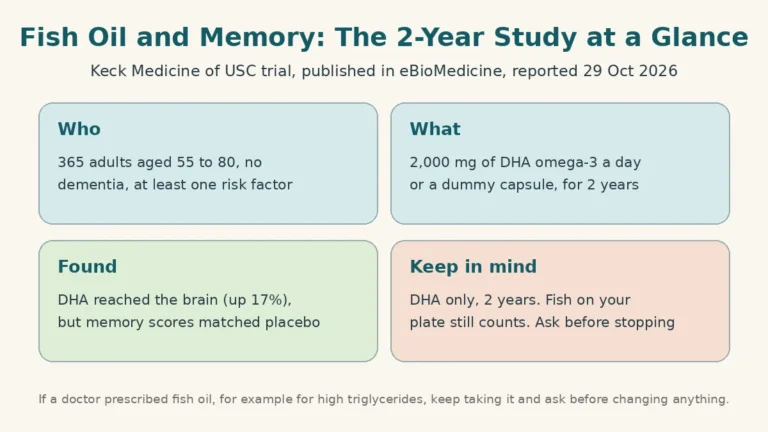
Fish oil does have one caution worth knowing. Earlier research found a possible link between high-dose omega-3 supplements and atrial fibrillation, an irregular heartbeat. Randomized tests have not found fish oil harmful for healthy older adults, and some suggest benefit for people with mild cognitive impairment, according to experts at the NIH Office of Dietary Supplements. Omega-3 levels can be measured in a blood test, so the sensible move is to ask about your dose rather than guess.
The vitamin D math: why it pays to add up every bottle
Vitamin D is fat-soluble, which means the body stores extra rather than flushing it out. That is why the total amount matters. Bottles vary a lot: one may give 1,000 IU a dose, another 5,000 IU. Add a multivitamin, a calcium-plus-D tablet or a fortified drink, and the daily total can creep up without anyone noticing.
The U.S. National Institutes of Health’s Office of Dietary Supplements sets the upper limit for adults at 4,000 IU (100 micrograms) a day from all sources combined. So a single 5,000 IU capsule is already above that line, unless your doctor has prescribed it for a measured deficiency. Too much can cause problems of its own and can interact with some medicines. A simple blood test tells you where you stand, which is far better than guessing.
Glucosamine and memory after 60: what to do this week
None of this calls for alarm. A calm, one-evening review is enough for most people:
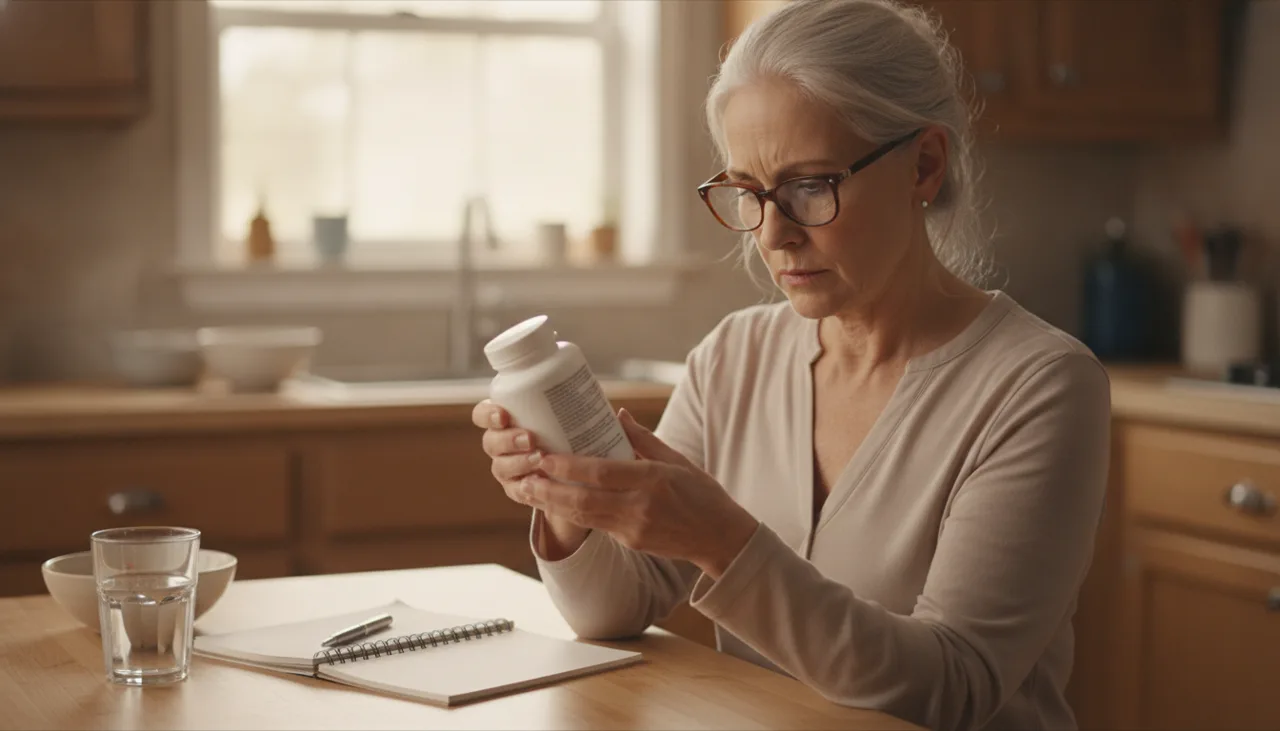
- List every bottle. Line up everything you take, including vitamins, joint formulas, fish oil, sleep aids and anything from the pharmacy shelf. Write down the name and the dose on each label.
- Add up your vitamin D. Check the multivitamin, the calcium tablet and any “bone” or “immune” blend as well as the vitamin D bottle itself. Compare the total with the 4,000 IU adult upper limit.
- Note the “why” for each one. Next to each supplement, write why you started it and whether it still seems to help. It makes the conversation with your doctor much quicker.
- Take the list to your doctor or pharmacist. Pharmacists are especially good at spotting overlaps and interactions, such as glucosamine with warfarin. Mention any memory concerns, for yourself or a parent.
- Never stop a prescribed medicine on your own. Supplements and prescriptions are different. If something was prescribed, talk to your doctor before changing it.
- Lean on food first. Experts in the Northeastern piece agree that no single vitamin or supplement has been proven to prevent or cure Alzheimer’s. A Mediterranean-style or MIND way of eating, with vegetables, beans, nuts, olive oil and fish, remains the safest everyday bet for the brain.
Supplements are only one small piece of brain health. Sleep, movement, good food and time with friends do much of the heavy lifting, and our free Guide to Living 7 Years Longer brings those everyday habits together in one place.
FAQ: glucosamine, vitamin D, fish oil and the brain
Should I stop taking glucosamine because of the new study?
Not on your own, and not in a panic. The study found a link, not proof, and the researchers say it does not yet show that people should stop. If you or a parent already has memory problems, or takes warfarin, ask your doctor or pharmacist whether glucosamine still makes sense for you.
Does glucosamine cause Alzheimer’s disease?
There is no proof of that. A University of Florida health-record study found that people with mild memory problems who used glucosamine were about 25% more likely to progress to dementia, but that is an association. A clinical trial is still needed to know whether glucosamine itself plays a part.
Is vitamin D bad for the brain after 60?
The best evidence so far is reassuring. The large VITAL trial of about 3,400 older adults found that vitamin D neither helped nor harmed thinking. The main thing to watch is the total dose, because the adult upper limit is 4,000 IU a day across all your pills.
Is fish oil safe for memory in older adults?
In randomized trials, fish oil has not been found to harm thinking in healthy older adults, and VITAL found it neither helped nor harmed. High doses have been linked with an irregular heartbeat called atrial fibrillation, so dose is worth discussing with your doctor.
What is the safest way to review my supplements?
Write down every bottle you take, including multivitamins, with the dose on each label. Add up the vitamin D, then take the list to your doctor or pharmacist. Never stop a prescribed medicine without talking to your doctor first.
Sources: UF Health, “Glucosamine, a popular joint supplement, linked to faster Alzheimer’s progression,” ScienceDaily, 27 September 2026, reporting Hawkinson TR, et al., “Hyperglycosylation is a metabolic driver of Alzheimer’s disease,” Nature Metabolism, 2026. Poltorak K, “Three trusted supplements are in the hot seat. Could they harm the aging brain?” Northeastern Global News, 22 September 2026. NIH Office of Dietary Supplements, Vitamin D Fact Sheet for Health Professionals.
Disclaimer: TurnBackClock.com shares educational information for adults 50+. Nothing here is medical advice, a diagnosis, or a treatment plan. Please talk to your doctor or pharmacist before starting, stopping or changing any supplement or medicine, and never stop a prescribed medicine on your own.