“Could something as simple as a fiber powder in my morning yogurt really help my knees?” That is the question many readers asked this week, after news that a daily prebiotic fiber eased knee pain in people with osteoarthritis. If your knees ache on the stairs or stiffen after sitting, you are far from alone: Arthritis UK says “six in ten people are living in pain most or all of the time due to their arthritis.” Here is a calm, plain-English look at the new research on an inulin supplement for joint pain, focused on knee arthritis: what the study found, what it did not, and how to try it sensibly. (Updated 2 November 2026 with more reader questions.)

What is inulin, and where do you find it?
Inulin is a natural plant fiber. You cannot digest it yourself, but the friendly bacteria in your gut love it. They ferment it and, in the process, make helpful substances such as butyrate, a short-chain fatty acid that helps keep the gut lining healthy and calms inflammation.
You may already eat some every week. Inulin is found in chicory root (the richest source, and the one most supplements use), onions, garlic, leeks, asparagus, slightly green bananas and Jerusalem artichokes. As a supplement it usually comes as a mild, slightly sweet white powder that stirs easily into yogurt, porridge, coffee or water.
What the new knee arthritis study found
The research comes from the University of Nottingham in England. It is called the INSPIRE trial, and it was published in the journal Nutrients in 2026 and reported by ScienceDaily on 27 October. The team followed 117 adults with knee osteoarthritis for six weeks and split them into four groups:
- a daily inulin fiber supplement,
- a digital physiotherapy exercise program done at home,
- both the fiber and the exercise, or
- a dummy (placebo) powder.
Here is what happened, in plain numbers:
- Less knee pain. Both the inulin group and the exercise group reported less knee pain than the placebo group.
- Stronger grip. The inulin group also improved their grip strength, a simple everyday sign of overall muscle strength as we age.
- Less sensitive to pain. People taking inulin became less sensitive to pain in tests, suggesting the effect was not only in the knee.
- Easy to stick with. Only 3.6% of people dropped out of the inulin-only group, compared with 21% of those doing the physio program alone. A spoonful of powder is simply easier to keep up than a new exercise plan.
- Gut changes. Blood levels of butyrate rose, and so did GLP-1, a natural gut hormone involved in appetite and blood sugar.
The researchers say the approach “could meaningfully reduce pain and improve physical function” by “adding a fiber supplement to your breakfast or yogurt.” That is encouraging, especially for a supplement that is cheap and generally well tolerated.
Why would gut bacteria affect your knees?
It sounds surprising at first, but scientists have been studying the gut-joint link for years. Osteoarthritis is not only wear and tear; low-level inflammation plays a part too. When gut bacteria ferment fiber, the butyrate they make seems to help calm that inflammation throughout the body. Changes in pain sensitivity and in hormones such as GLP-1 may also play a role. It is still an early idea, but this trial adds weight to it.
What this study does not tell you
A good result deserves an honest look at its limits, and the authors were clear about them:
- It was relatively small. 117 people across four groups is a modest number. Bigger studies need to confirm the result.
- It lasted only six weeks. We do not yet know whether the benefit lasts, grows or fades over months and years.
- Fiber should not replace exercise. The researchers said this directly. Strength and movement remain the foundation of caring for arthritic knees.
One easy way to keep an eye on the strength around your knees is to repeat the same simple test every few weeks. Our free 30-second chair stand test takes half a minute, needs only a sturdy chair, and shows typical scores for your age group.
How to try an inulin supplement for joint pain sensibly
- Ask first. Have a quick word with your doctor or pharmacist, especially if you have IBS or another bowel condition, diabetes, or take regular medicines.
- Food first. Add more onions, leeks, garlic, asparagus and the occasional Jerusalem artichoke to your meals. A slightly green banana with breakfast counts too.
- Start low and go slow. If you try a powder, begin with a small amount, such as half a teaspoon a day, and build up over two to three weeks. Too much too soon is the main cause of gas and bloating.
- Drink enough water. Fiber works best with plenty of fluid.
- Keep moving. Carry on with walking, chair exercises and simple leg strength work. Think of fiber as an add-on, not a swap.
- Keep a simple log. Note your knee pain from 0 to 10 each day for a few weeks. It is the honest way to see whether anything is changing for you.
Inulin, glucosamine or the new “healing peptides”?
Sore knees send many of us down a long supplement aisle. On Reddit this week, one reader asked what actually helps knee cartilage and ligaments heal, and listed everything they had tried: “collagen peptides, HA, chondroitin, glucosamine, protein, creatine, msm, tumeric, boron, Omega 3 and many many more.” Another replied simply: “Nothing works. I tried them all.” A third pointed out that “PT is the first line approach and often overlooked.”
At the same time, injectable “wellness peptides” such as BPC-157 and TB-500 are in the news. AP reported on 28 October that a new U.S. policy tells the FDA not to act against specialty pharmacies selling several of them, even though most FDA scientists reportedly opposed the move. Easier to buy is not the same as proven. These peptides have very little human research behind them, they are injected, many are sold online as “research use only,” and in 2023 the FDA listed concerns including allergic reactions, kidney damage and tumor growth.
Seen side by side, inulin looks refreshingly modest: a food fiber, cheap, taken by mouth, generally well tolerated, and now backed by one small randomized trial. It is still not a cure. The best-supported help for arthritic knees remains the unglamorous trio of regular movement, leg-strength work and, where needed, a few sessions with a physiotherapist.
Small, steady habits tend to add up after 50. For more of them, from strength to sleep to eating well, download our free guide to living well for longer.
This summary draws on the University of Nottingham INSPIRE trial published in Nutrients (2026; 18(5): 714), as reported by ScienceDaily, with background from Arthritis UK and AP reporting on the FDA and peptides (28 October 2026).
This article is for general information only and is not medical advice. Please speak with your doctor or pharmacist about your own health, especially before starting, stopping or changing any supplement or medicine.
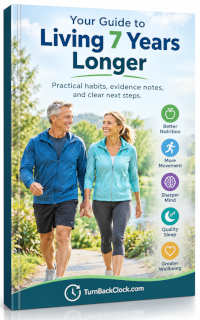
Get the Free Guide
Instantly receive Your Guide to Living 7 Years Longer — practical habits, evidence notes, and clear next steps. Soft mentions of our free longevity tools are inside. No miracle promises.
We’ll never share your email. You can unsubscribe anytime.
Frequently asked questions
What is inulin?
Inulin is a type of plant fiber. Your body cannot digest it, but the friendly bacteria in your gut can. It is found naturally in chicory root, onions, garlic, leeks, asparagus, bananas and Jerusalem artichokes, and it is also sold as a powder or capsule supplement.
Can a fiber supplement really help knee arthritis pain?
In one recent six-week trial of 117 adults with knee osteoarthritis, people who took inulin reported less knee pain than those on a dummy powder, about as much as people who did a home exercise program. It is a promising early result, but the study was small and short, so it is not proof yet.
Should I take inulin instead of doing my knee exercises?
No. The researchers said fiber should not replace exercise. Strength and movement work remain the best-supported way to ease knee arthritis. Think of fiber as a possible add-on to your routine, not a swap.
Does inulin cause gas or bloating?
It can, especially at first. Starting with a small amount, increasing slowly over a couple of weeks and drinking enough water usually helps. If you have a bowel condition such as IBS, or you take regular medicines, check with your doctor or pharmacist before starting.
Is there a study on inulin supplements and joint pain?
Yes. The INSPIRE trial from the University of Nottingham, published in Nutrients in 2026, followed 117 adults with knee osteoarthritis for six weeks. Those taking a daily inulin fiber supplement reported less knee pain than those on a dummy powder. It is one small, short study, so larger and longer trials are still needed.
Does inulin help arthritis in other joints, like hips or hands?
We do not know yet. The new trial only looked at knee osteoarthritis. Because the proposed effect works through the gut and whole-body inflammation, researchers think it could matter more widely, but that has not been tested, so treat any benefit for hips, hands or other joints as unproven.
Are injectable peptides like BPC-157 a better option for knee pain?
There is very little human evidence for peptides such as BPC-157 or TB-500, they are injected, and many are sold as research chemicals. The FDA has raised concerns about allergic reactions, kidney damage and tumor growth. Talk with your doctor before considering them, and remember that exercise and physiotherapy have far stronger support.