Short answer: yes, most people’s usual pace drifts down a little with the years, and it is very common to notice your walking speed after 60 for the first time when friends, or strangers on the pavement, keep slipping past you. But a slower stride is not something you simply have to accept. Pace is built from leg strength, ankle movement, balance and confidence, and every one of those can be trained. Below is a simple home self-check you can do with a phone timer, what the research says about typical speeds, and a gentle four-week plan to rebuild your pace. This guide is educational only, not personal medical advice.
The question came from a 64-year-old in an online group about ageing: they had started to notice that people walk faster than them, and wondered whether getting older really means walking slower. The replies were honest. One 63-year-old said they used to be a real speed walker and now have to push themselves. A 59-year-old said the two things worth keeping strong are walking pace and grip strength. And a 68-year-old who still walks faster than most people credited weight training, and suggested looking up ways to make the ankles more flexible. That last reply is close to what the research suggests, too.

Is it normal to walk slower as you get older?
Some slowing is normal. A large review that pooled 41 studies and more than 23,000 healthy adults found that average comfortable pace ranged from about 1.43 metres per second for men in their forties down to about 0.94 metres per second for women aged 80 to 99 (Bohannon and Williams Andrews, 2011). In other words, the change is gradual, it happens to almost everyone, and it is spread over decades rather than arriving overnight.
What matters more than any single number is your trend. A pace that has eased a little over ten years is very different from one that has dropped noticeably in a few months. Researchers often call usual walking pace a useful everyday marker of fitness, because it quietly reflects how well your muscles, joints, heart, lungs, balance and nervous system are working together.
Why your pace drifts after 60
A slower stride rarely has just one cause. Usually several small things stack up:
- Less leg strength. Each step is a push-off from the calf, thigh and hip muscles. As muscle mass slowly declines, steps get shorter and the push gets softer.
- Stiffer ankles. If your ankle does not bend well, your foot cannot roll through the step, so your stride shortens. This is the reason the 68-year-old’s tip about ankle flexibility is a good one.
- Balance. When you feel a little unsteady, your body widens your stance and shortens your step to stay safe. It works, but it costs speed.
- Confidence. After a trip, a fall, or just a scare on an icy path, many people walk more cautiously without realising it. Caution is sensible, but it can become a habit that outlasts the reason for it.
- Eyes and ears. Glare, cataracts, or varifocal glasses that blur the ground make people look down and slow down. Hearing also helps you sense what is moving around you, so a busy, noisy street can feel harder to stride through.
- Aches, feet and shoes. Sore knees, hips or feet, and worn or slippery shoes, all shorten the stride.
- Stamina. If your heart and lungs are less used to brisk effort, your body naturally picks a gentler pace.
The encouraging part is that most of these respond to practice. That is why it makes sense to treat pace as a fitness skill you can rebuild, rather than a fixed sign of age.
First: when to check with your doctor
Please talk to your doctor before trying the self-check or the plan below if you have had falls, dizziness, or sudden changes in how you walk. That includes:
- A fall or a near-fall in the past year, or a new fear of falling
- Dizziness, light-headedness or feeling faint when you stand or walk
- A sudden change in pace, a new shuffle, or one leg that drags or feels weak
- Chest pain, unusual breathlessness or palpitations when you walk
- Numbness in your feet, new or severe joint pain, or recent surgery
If weakness, numbness, confusion or trouble speaking comes on suddenly, especially on one side of the body, call your local emergency number straight away. A physical therapist is also a great person to see about walking pace and confidence. They do this kind of testing every day.
A simple 4-metre walking speed self-check
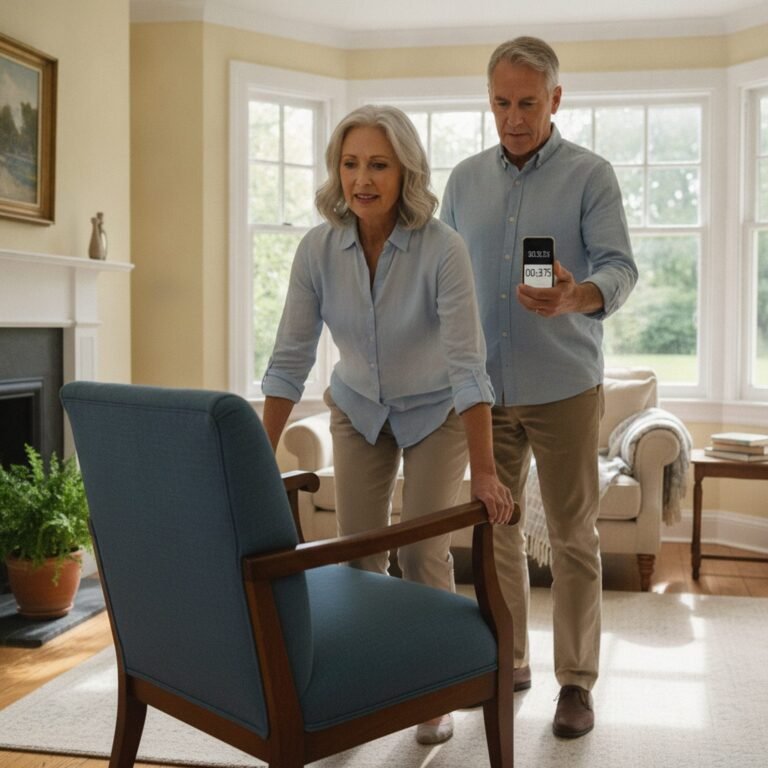
Clinicians often time a short walk at your usual pace. You can do a home version in about five minutes. A helper with a phone makes it easier and safer.
What you need
- A flat, clear, well-lit stretch of about 6 metres (20 feet): a hallway, a driveway or a quiet path, with no rugs or steps
- A tape measure and two markers, such as tape on the floor or two shoes
- A phone with a stopwatch, and ideally a helper to work it
- Your everyday shoes and any walking aid you normally use
How to do it
- Mark the course. Put a start marker, then measure exactly 4 metres (about 13 feet) and put a finish marker. Leave about a metre of space before the start and after the finish.
- Usual pace. Stand a step behind the start line. Begin walking at your normal, everyday pace, as if you were walking to the shops. Your helper starts the timer as your first foot crosses the start line, and stops it as your first foot crosses the finish line. Keep walking past the finish so you do not slow down early.
- Repeat once. Rest for a moment, walk back, and do it again. Write down the faster of the two times.
- Brisk pace (optional). If you feel steady, do two more walks “as quickly as feels safe and comfortable”, without running. Write down the faster time.
- Work out your speed. Divide 4 by your time in seconds. For example, 4 metres in 4 seconds is 1.0 metre per second.
Stop if you feel dizzy, unsteady or short of breath, and stay close to a wall or a helper.
Reading your result
| Time for 4 metres | Walking speed |
|---|---|
| 3.0 seconds | about 1.33 metres per second |
| 3.3 seconds | about 1.2 metres per second |
| 4.0 seconds | about 1.0 metre per second |
| 4.4 seconds | about 0.9 metres per second |
| 5.0 seconds | about 0.8 metres per second |
| 6.0 seconds | about 0.67 metres per second |
For context, in a large pooled study of more than 34,000 adults aged 65 and over (average age about 73), the average usual pace was 0.92 metres per second, which is roughly 4.3 seconds over 4 metres (Studenski et al., 2011). In the same study, a faster usual pace went along with better long-term health, step by step across the whole range, which is one more reason to look after it. A home test is only a rough guide, though. It cannot diagnose anything or tell you about your future. Its real value is as your own baseline.
The gap between your usual and brisk times is useful, too. If you can speed up easily, you have reserve, and the plan below is about making that brisker pace feel normal. If you cannot speed up much, strength and balance are the best places to start.
How much change is worth noticing? Researchers who studied older adults suggested that an improvement of about 0.05 metres per second is a small but meaningful change, and about 0.10 metres per second is a substantial one (Perera et al., 2006). Over 4 metres, that is only a few tenths of a second, so time yourself carefully and in the same way each week.
How to rebuild your pace safely: a gentle four-week plan
Aim for three sessions a week on non-consecutive days, about 20 to 30 minutes each. Start easy. You should finish feeling pleasantly worked, not wiped out. If anything hurts, stop that move and ask a physical therapist for an alternative.
1. Ankle mobility (5 minutes, daily if you like)
- Seated ankle circles and pumps: sit tall, lift one foot, and draw 10 slow circles each way, then point and flex the foot 10 times. Swap feet.
- Knee-to-wall stretch: stand facing a wall with your hands on it and one foot a few inches back from the wall. Keeping that heel down, gently bend the knee towards the wall until you feel a stretch in the ankle and calf. Do 10 slow reps on each side.
- Heel raises at the counter: hold the kitchen counter, rise up onto your toes, pause, and lower slowly. Do 10 to 15. Strong calves give you a better push-off.
2. Sit-to-stands (leg power)
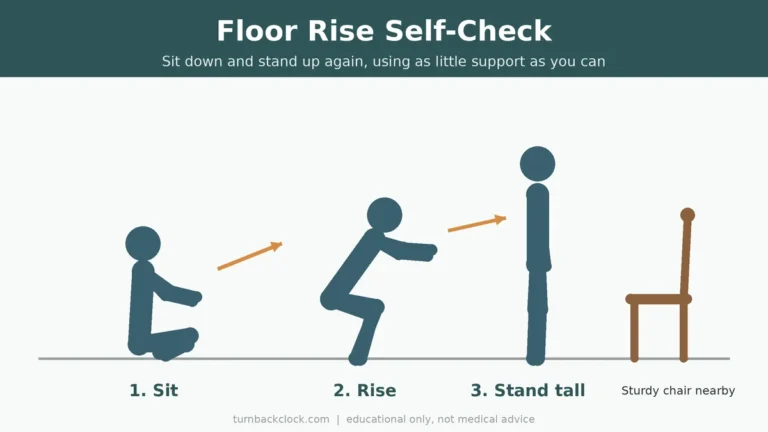
Use a sturdy chair without wheels, with its back against a wall. Sit near the front edge, feet flat and hip-width apart. Lean forward a little, then stand up fully, and sit back down slowly. Use your hands on your thighs or the armrests if you need to. Do 2 or 3 sets of 5 to 10, resting a minute between sets. As it gets easier, try standing up a little faster, under control, and lowering more slowly. That brisk “up” is the same leg power you use to stride out.
3. Short interval walks
Walk on a flat, safe route. Warm up with 5 minutes at an easy pace. Then walk briskly for 1 minute (you can still talk, but not sing), followed by 2 minutes of easy walking. Repeat that brisk-and-easy pair 3 to 5 times, then cool down for 5 minutes. Think “tall body, swing your arms, push off through your toes”. A walking pole or a companion can help your confidence.
4. A minute of balance
Stand at the kitchen counter and practise standing with one foot in front of the other, heel to toe, for up to 30 seconds each way. Rest a fingertip on the counter if you need it. Better balance lets your body take longer, more confident steps.
Your four weeks at a glance
| Week | Sit-to-stands | Interval walk |
|---|---|---|
| 1 | 2 sets of 5 | 3 rounds of 1 minute brisk, 2 minutes easy |
| 2 | 2 sets of 8 | 4 rounds |
| 3 | 3 sets of 8 | 4 rounds, brisk part a little quicker |
| 4 | 3 sets of 10 | 5 rounds |
Do the ankle and balance moves before each session. If a week feels too hard, simply repeat it. Progress is progress, whatever the speed.
If you would like a ready-made routine for the strength part, our simple exercise guide for older adults walks you through gentle moves you can do at home.
Track your walking speed after 60, week by week
Repeat the 4-metre usual-pace walk once a week, on the same course, at the same time of day, in the same shoes. Write down the date, your best time and how you felt. A small notebook on the fridge works well. Many people find that the numbers move slowly but steadily over a couple of months, and that day-to-day walking feels lighter long before the stopwatch shows much. If your time gets clearly slower instead, or you notice any of the warning signs above, that is a good reason to see your doctor.
Get the Free Guide
Instantly receive Your Guide to Living 7 Years Longer — practical habits, evidence notes, and clear next steps. No miracle promises.
We’ll never share your email. You can unsubscribe anytime.
Walking pace sits alongside sleep, food, strength and friendships as one of the everyday habits that support healthy ageing. Our free Guide to Living 7 Years Longer brings those habits together in one place.
FAQ: walking pace after 60
Is it true that people walk slower as they get older?
On average, yes. Large studies show usual walking pace eases gradually with each decade. But there is a wide range at every age, and many people in their sixties and seventies keep a brisk pace by staying strong, mobile and active.
How can I test my walking speed at home?
Mark out 4 metres on a flat, clear surface, start walking a step before the line, and have a helper time you at your usual pace with a phone stopwatch. Take the faster of two tries and divide 4 by the seconds to get metres per second.
Can you improve your walking pace after 60?
Many people can. Leg strength, ankle mobility, balance and stamina all respond to regular, gentle training such as sit-to-stands, heel raises and short brisk walking intervals.
How often should I retest my walking speed?
Once a week is plenty. Use the same course, shoes and time of day so that your results are comparable.
When should a slower pace worry me?
See your doctor if your pace changes suddenly, if you have had falls or dizziness, or if one leg feels weak, drags or goes numb. Sudden one-sided weakness, confusion or trouble speaking needs emergency care.
Sources: Bohannon RW, Williams Andrews A. Normal walking speed: a descriptive meta-analysis. Physiotherapy, 2011 (PMID 21820535). Studenski S, et al. Gait speed and survival in older adults. JAMA, 2011 (PMID 21205966). Perera S, et al. Meaningful change and responsiveness in common physical performance measures in older adults. J Am Geriatr Soc, 2006 (PMID 16696738).
Disclaimer: TurnBackClock.com shares educational information for adults 50+. Nothing here is medical advice, a diagnosis, or a treatment plan. Please check with your doctor if you’ve had falls, dizziness, or sudden changes in how you walk, and before starting a new exercise routine.