After 50, strength and balance tend to change quietly. You may not notice until stairs feel harder or you reach for the counter more often. The good news: a few simple, well-studied tests can give you a clear starting point at home in about 10 minutes — and a way to track progress every few months.
The tests below are adapted from the CDC’s STEADI (Stopping Elderly Accidents, Injuries) clinical resources, which clinicians use to screen adults 65+ for fall health risk. They are screening tools, not a diagnosis. If you feel unsteady, have dizziness, recent surgery, or a heart or joint condition, check with your doctor first and always have a helper nearby.
Before you start: set up safely
- Use a sturdy chair without wheels, pushed against a wall (about 17 inches / 43 cm seat height).
- Wear supportive shoes and clear the floor of rugs and clutter.
- Stand next to a kitchen counter or have a partner within arm’s reach for balance tests.
- Have a phone timer ready, and write your results down with today’s date.
Test 1: The 30-Second Chair Stand (leg strength)

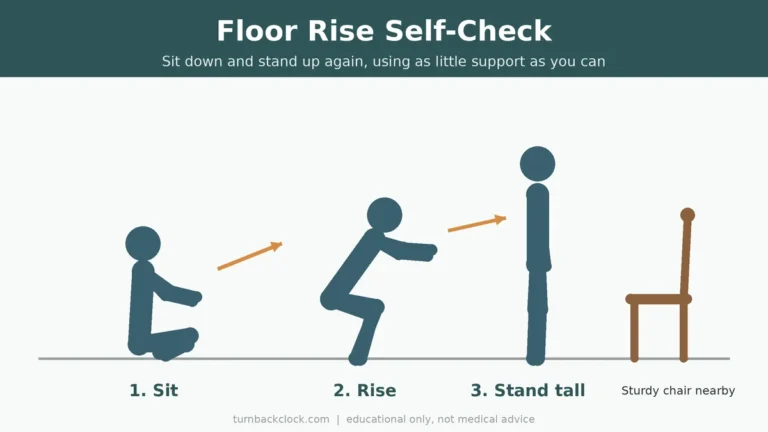
Leg strength is one of the best everyday predictors of independence: getting up from a chair, the toilet, or the car all depend on it. In the 30-Second Chair Stand, you sit in the middle of the chair, cross your arms over your chest, and count how many times you can fully stand up and sit back down in 30 seconds. The test was developed and validated by Jones, Rikli and Beam in community-dwelling older adults (Research Quarterly for Exercise and Sport, 1999).
Our free Chair Stand Test after 50 walks you through each step and compares your count with CDC STEADI reference ranges for your age and sex. For example, CDC lists a score below 12 stands as below average for women aged 60–64 and below 14 for men of the same age.
Test 2: The 4-Stage Balance Test (static balance)
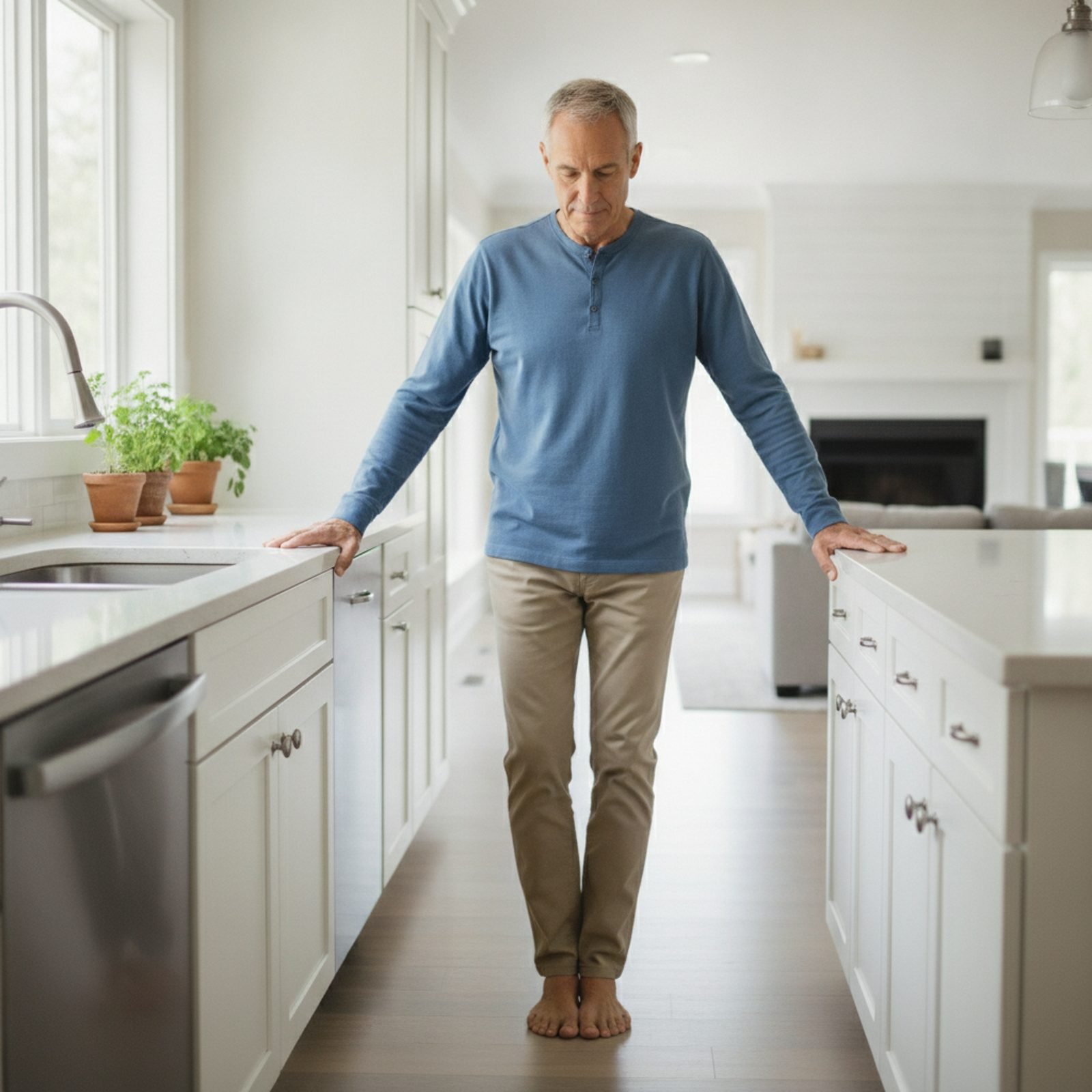
This CDC STEADI test progresses through four positions, each held for 10 seconds without support: feet side by side, instep of one foot touching the big toe of the other (semi-tandem), heel-to-toe (tandem), and standing on one foot. According to CDC, if you cannot hold the tandem stance for 10 seconds, your fall health risk is higher than average — a useful signal to start balance practice.
Try our free 4-Stage Balance Test after 50 for printable instructions and a simple way to log your result.
Building from these checks toward everyday stairs? Read stairs getting harder after 70: a free at-home plan.
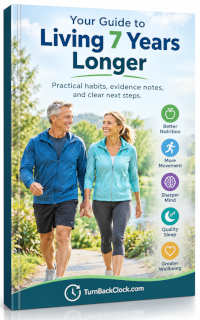
Get the Free Guide
Instantly receive Your Guide to Living 7 Years Longer — practical habits, evidence notes, and clear next steps. No miracle promises.
We’ll never share your email. You can unsubscribe anytime.
Test 3: The Timed Up and Go (mobility)

Sit in the chair, then on “go” stand up, walk at your normal pace to a line 10 feet (3 m) away, turn around, walk back and sit down. CDC STEADI notes that taking 12 seconds or longer suggests a higher fall health risk. The test was first described by Podsiadlo and Richardson (Journal of the American Geriatrics Society, 1991). Pay attention to how you move, too: a slow, shuffling turn or reaching for walls is worth noting.
What your results mean — and what to do next
One score is just a snapshot. What matters is the trend. The encouraging part is that strength and balance respond to training at any age. A large Cochrane review of 108 trials found that exercise programs — especially those combining balance and functional strength — reduced the rate of falls in older adults living in the community by about 23% (Sherrington et al., 2019).
- Strength: practice sit-to-stands, step-ups and heel raises 2–3 days a week. The National Institute on Aging recommends a weekly mix of aerobic, muscle-strengthening and balance activities.
- Balance: short daily practice works well — see how often to practice balance exercises after 50.
- Walking: build a steady daily habit; our guide on how many steps a day to walk after 50 helps you set a realistic target.
- Retest: repeat all three tests every 8–12 weeks under the same conditions.
When to talk with a professional: if you scored below the CDC cut-offs, have fallen in the past year, feel unsteady, or worry about falling, tell your doctor. A physical therapist can build a safe, personal plan.
More free tools
Want a bigger picture of how you are aging? Browse all our free longevity tools — including quick self-checks for energy, sleep and habits — and track your progress over time.
Sources
- CDC STEADI – Clinical Resources (30-Second Chair Stand, 4-Stage Balance Test, TUG)
- CDC – Older Adult Falls Data
- NIH National Institute on Aging – Types of Exercise That Improve Your Health and Physical Ability
- Jones CJ, Rikli RE, Beam WC. A 30-s chair-stand test as a measure of lower body strength in community-residing older adults. Res Q Exerc Sport. 1999.
- Podsiadlo D, Richardson S. The timed “Up & Go”. J Am Geriatr Soc. 1991.
- Sherrington C, et al. Exercise for preventing falls in older people living in the community. Cochrane Database Syst Rev. 2019.
This article is for general education and is not medical advice. Always consult your healthcare provider before starting a new exercise program.