Here is a test you can do right now. Go and grab your NMN bottle. Turn it over and find the batch number, a short code usually printed near the best-before date. Now ask yourself one question: has anyone outside the company checked what is inside this exact batch? If you do not know, you are not alone, and it matters more than most people think.
When a lab tested 22 of the most popular NMN products sold on Amazon in 2021, 14 of them contained less than 1 percent of the NMN on the label. Three had none that could be detected. This guide shows you how to read an NMN certificate of analysis, often shortened to CoA, in about two minutes, so you know you are paying for real NMN. This is not medical advice.

What that 22-product test actually found
The test was carried out by ChromaDex, a company that sells a rival NAD+ booster called nicotinamide riboside (NR), so it is fair to read it with that in mind. The lab bought one product from each of the 22 NMN brands with the biggest share on Amazon in mid-2021 and measured the NMN in each using a standard method called HPLC (high-performance liquid chromatography).
- 3 products had the full amount of NMN on the label or more.
- 5 products were close, at 88 to 99 percent of the label amount.
- 14 products, about two in three, had less than 1 percent of the NMN claimed. Three of those had no NMN detected at all.
- Ten of the low products listed the same distributor and looked almost identical in the lab, which suggests one source behind many brand names.
ConsumerLab, an independent testing company, has since tested NMN and other NAD+ boosters from better-known brands and found that most of those did contain what the label said. So the takeaway is not “all NMN is fake.” It is that quality varies hugely, and a certificate of analysis is the quickest way to tell the careful brands from the rest.
How to read an NMN certificate of analysis in 2 minutes
A certificate of analysis is simply a lab report for one batch of a product. It can look technical, but you only need to find six things.
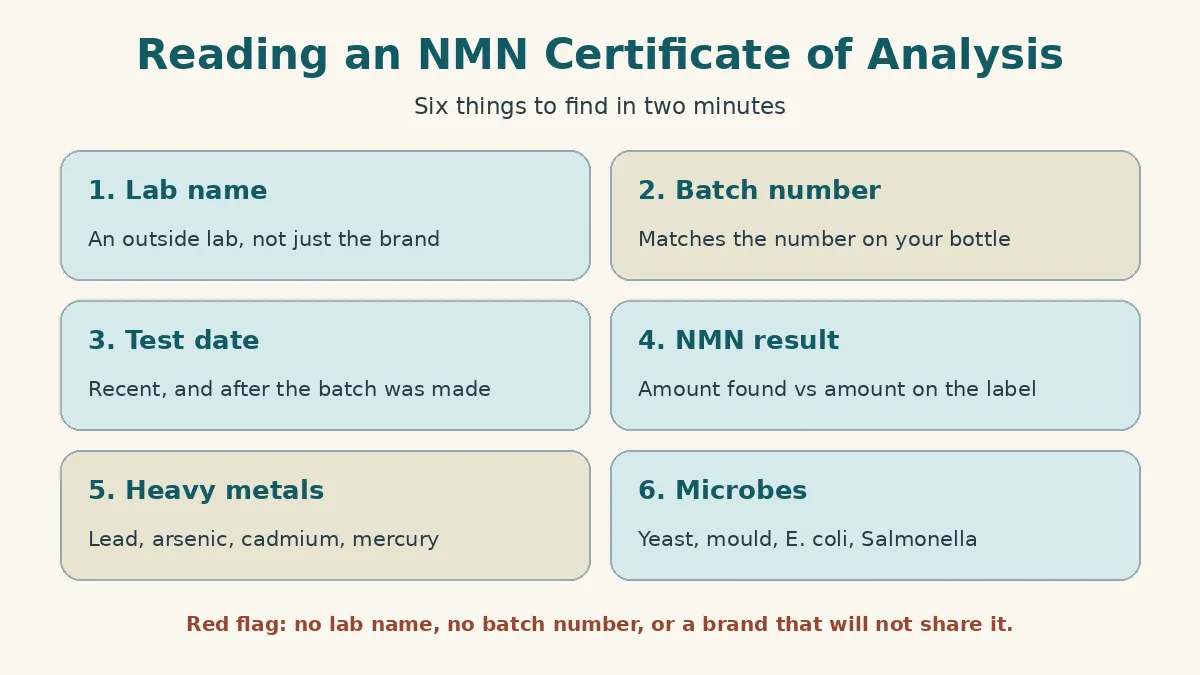
1. The lab’s name
Look for the name of an outside testing lab, ideally one accredited to the ISO/IEC 17025 standard for testing labs. A sheet with only the brand’s own logo and no lab name is an in-house report. That is better than nothing, but it is the company checking its own homework.
2. A batch number that matches your bottle
This is the step most people skip. The CoA should show a batch or lot number, and it should match the one printed on your bottle. A single “sample” certificate from years ago tells you about that old batch, not the one in your kitchen.
3. The test date
Check that the test is recent and fits with when your batch was made. A certificate dated long before your bottle’s production date is a reason to ask questions.
4. The NMN result: found versus claimed
You will often see “purity 99%” on supplier sheets. That number describes the raw powder before it goes into capsules. The more useful line is the assay, meaning how much NMN the lab actually found per capsule or per serving, next to what the label promises. A result near 100 percent of the label amount is what you want. A result of “not detected” or “below reporting limit” is a clear no.
5. Heavy metals
A good CoA lists lead, arsenic, cadmium and mercury, each with a result and a limit, and shows the product passed. If metals are missing entirely, ask why.
6. Microbes
Look for results for total bacteria count, yeast and mould, and tests for E. coli and Salmonella, usually marked as “absent” or “pass.” This matters for any powder or capsule you take every day.
Red flags that should make you pause
- No lab name, no address and no signature.
- No batch number, or a batch number that does not match your bottle.
- Only a supplier’s raw-powder certificate, with no test of the finished capsules.
- Perfectly round numbers everywhere, or a document that looks edited.
- A brand that will not send you the CoA when you ask with your batch number.
- Big promises on the label, such as “reverse aging.” Calm, specific wording is a better sign.
Myth or fact: “If it is sold online, it must have been checked”
Myth. In most countries, supplements are not tested by regulators before they go on sale. Checking that the bottle contains what it says is largely left to the brand. That is exactly why the certificate of analysis matters, and why brands that publish batch-matched, third-party results deserve your money more than brands that do not.
Why it is worth getting this right
NMN is one of the most promising supplements people over 50 are trying. Your body uses it to make NAD+, a molecule cells need for energy and repair that tends to fall with age, and small human trials have found NMN raises NAD+ in the blood and appears well tolerated over a few months. Some have also seen hopeful early signals for walking speed and sleep, though none prove NMN slows aging. If you decide to try it, it only makes sense if the capsule actually contains NMN. A real product at the studied dose of roughly 250 to 900 mg a day is the whole point.
To save you the legwork, our best NMN supplement comparison puts four brands side by side on testing, dose and cost per day, and our guide on how to choose an NMN supplement after 50 covers the other five label checks. If you already own one, our NMN Bio 500 mg review shows how we look at a single product.
Before spending money each month, it also helps to know where you are starting from. Our free biological age calculator takes a few minutes and shows which everyday habits are pulling your score up or down, the things that matter before any supplement.
If you would like the simple habits that come first, our free guide to living 7 years longer is a gentle place to start.
Sources: ChromaDex, “Quantitative Analysis of Twenty-Two NMN Consumer Products” (October 2021), as reported by NutraIngredients (January 2022); ConsumerLab.com NAD Booster Supplements Review (NMN, NR and NADH tests). The test of 22 products was a single snapshot from 2021 and does not name every brand on sale today.
Disclaimer: TurnBackClock.com shares educational information for adults 50+. Nothing here is medical advice, diagnosis or a treatment plan. Talk to your doctor or pharmacist before starting NMN, especially if you take regular medicines, are being treated for cancer, or are pregnant or planning a pregnancy.
Get the Free Guide
Instantly receive Your Guide to Living 7 Years Longer — practical habits, evidence notes, and clear next steps. Soft mentions of our free longevity tools are inside. No miracle promises.
We’ll never share your email. You can unsubscribe anytime.
Where to compare the NMN brands we reviewed
A certificate of analysis is one check. If you then want to compare tested products, these are the four NMN brands we have reviewed.
Disclosure: Some links above are affiliate links. If you purchase through them, Turn Back Clock may earn a commission at no additional cost to you.
Frequently asked questions
What is a certificate of analysis for NMN?
A certificate of analysis (CoA) is a lab report for one batch of a product. For NMN it should show how much NMN was found, plus checks for heavy metals and microbes, along with the lab’s name, the batch number and the test date.
Where do I find the CoA for my NMN supplement?
Many careful brands post it on the product page or let you type in the batch (lot) number printed on the bottle. If you cannot find it, email the company with your batch number and ask for the certificate of analysis for that batch. A good brand will send it.
What NMN purity should a CoA show?
Brands commonly list raw NMN powder at 98 to 99 percent purity. That figure is about the raw powder. For capsules, the more useful line is the amount of NMN per capsule found by the lab compared with the amount on the label, ideally from a test of the finished product.
Is a supplier’s CoA good enough?
It is a start, but not the whole story. A supplier’s certificate tests the raw powder before it goes into capsules. A test of the finished capsules, ideally by an independent lab, tells you what is actually in your bottle.
Does a good CoA mean NMN will work for me?
No. A CoA tells you the product contains what it says. It does not prove a benefit. Small human trials suggest NMN raises NAD+ levels in the blood and appears well tolerated over a few months, but long-term effects are not known. Talk to your doctor before starting.