
Introduction:
Every heartbeat, every thought, every moment your body spends repairing itself runs on the same currency: cellular energy.
At the molecular level, this energy is a compound called ATP (adenosine triphosphate), produced primarily inside tiny organelles called mitochondria. As we age, our capacity to generate ATP efficiently declines — and this decline is now recognized as one of the central drivers of the aging process itself, not just a symptom of it.
Understanding cellular energy isn’t just academic. It explains why fatigue creeps in with age, why muscles weaken, why recovery from illness slows, and why certain lifestyle choices can meaningfully change how we feel and function decades from now.
This article breaks down what cellular energy is, why it fades with age, and what the science says about protecting it.
What Is Cellular Energy, Really?
Inside nearly every cell in your body — with the notable exception of mature red blood cells — are mitochondria, often called the “powerhouses of the cell.” Mitochondria convert the food you eat and the oxygen you breathe into ATP, the molecule that powers virtually every biological process: muscle contraction, nerve signaling, protein synthesis, DNA repair, and the maintenance of cellular structure.
A typical cell contains hundreds to thousands of mitochondria, and metabolically demanding tissues — the heart, brain, and skeletal muscle — are especially rich in them. The process of converting nutrients into ATP, called oxidative phosphorylation, is remarkably efficient, but it comes with a byproduct: reactive oxygen species (ROS), often called free radicals.
In small amounts, ROS act as useful signaling molecules. In excess, they damage mitochondrial DNA, proteins, and membranes, setting off a cycle of declining efficiency.
How Cellular Energy Changes With Age
Research spanning decades has consistently found that mitochondrial function declines with age across nearly every tissue studied. Several interconnected changes drive this:
- Reduced mitochondrial density and efficiency. Aging tissues tend to have fewer mitochondria, and the ones that remain often produce less ATP per unit of oxygen consumed. This is sometimes described as a drop in “bioenergetic capacity.”
- Mitochondrial DNA damage. Unlike the DNA in the cell’s nucleus, mitochondrial DNA (mtDNA) is not as well protected and sits close to the site of ROS production. Over a lifetime, mtDNA accumulates mutations and deletions, which can impair the machinery that builds ATP.
- Reduced mitochondrial quality control. Cells have a built-in recycling system — called mitophagy — that identifies and clears out damaged mitochondria. This quality-control process becomes less efficient with age, allowing dysfunctional mitochondria to accumulate and drag down the energy output of the entire cell.
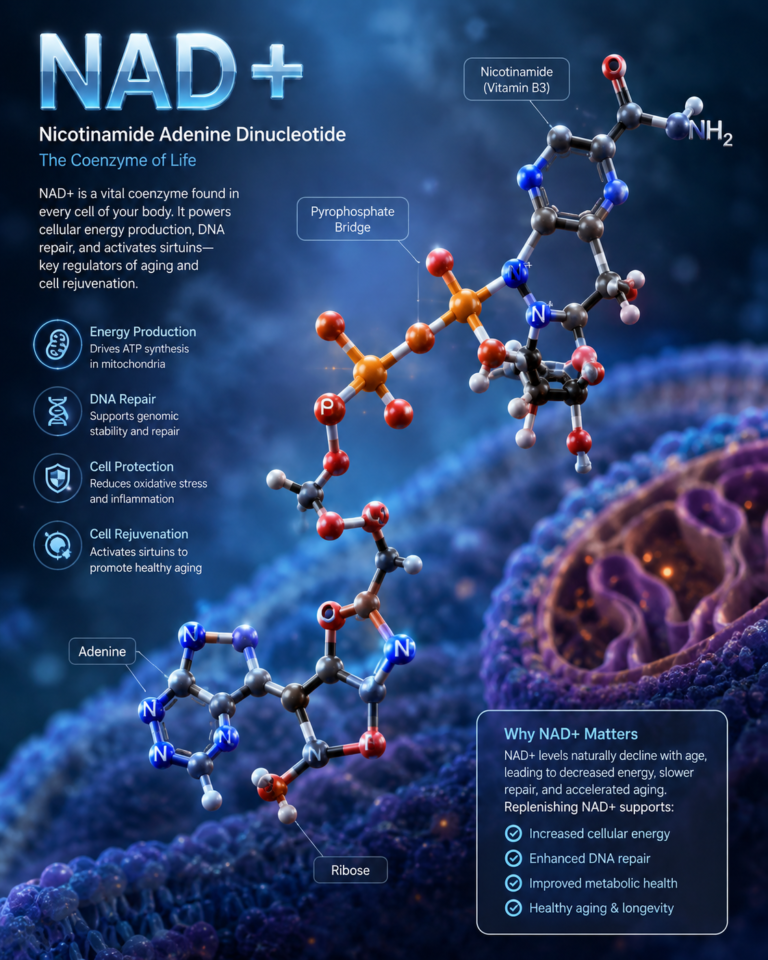
- Declining levels of NAD+. NAD+ (nicotinamide adenine dinucleotide) is a coenzyme essential for the chemical reactions that produce ATP and for activating proteins involved in cellular repair. NAD+ levels have been shown to fall significantly as people age, and this decline is thought to be a key contributor to reduced mitochondrial resilience.
- Chronic low-grade inflammation. Aging is associated with a subtle, persistent rise in inflammatory signaling sometimes called “inflammaging.” Damaged mitochondria can release molecular fragments that the immune system interprets as danger signals, feeding this inflammatory cycle and further stressing energy metabolism.
Why Cellular Energy Decline Matters for Healthy Aging
Mitochondrial dysfunction doesn’t stay contained — it ripples outward into nearly every hallmark of aging that longevity researchers track:
1. Muscle and physical function: Skeletal muscle is highly dependent on mitochondrial output. Declining energy production contributes to sarcopenia (age-related muscle loss) and reduced physical resilience.
2. Cognitive health: The brain consumes a disproportionate share of the body’s energy budget. Neurons are especially vulnerable to energy shortfalls, and mitochondrial dysfunction is a recurring theme in research on age-related cognitive decline.
3. Metabolic health: Efficient cellular energy production supports healthy blood sugar regulation. Impaired mitochondrial function is linked to insulin resistance and metabolic syndrome.
4. Cardiovascular health: The heart is one of the most mitochondria-dense tissues in the body, and cardiac energy metabolism is closely tied to long-term heart health.
5. Cellular resilience and repair: ATP powers the repair machinery cells use to fix DNA damage and maintain protein quality. When energy is scarce, these repair processes are among the first to be scaled back.
Because of these connections, many longevity researchers view supporting mitochondrial and cellular energy function as a foundational strategy for healthy aging — not a cure-all, but a lever that touches multiple biological systems at once.
Lifestyle Factors That Support Cellular Energy
While no lifestyle change can fully reverse the biological aging clock, a substantial body of research points to specific, actionable habits that support mitochondrial health and cellular energy production.
Exercise, especially a mix of aerobic and resistance training. Physical activity is one of the most well-established stimulators of mitochondrial biogenesis — the process of building new mitochondria. Aerobic exercise in particular has been shown to increase mitochondrial density and improve their efficiency, even in older adults who begin exercising later in life.
Time-restricted eating and occasional caloric moderation. Periods of reduced caloric intake or extended time between meals appear to activate cellular “clean-up” processes, including autophagy and mitophagy, that clear out damaged cellular components and may support more efficient mitochondrial turnover.
Prioritizing sleep. Sleep is when much of the body’s cellular repair and mitochondrial quality control takes place. Chronic sleep disruption has been associated with impaired mitochondrial function in multiple studies.
A nutrient-dense diet. Diets rich in polyphenols (found in colorful fruits and vegetables), omega-3 fatty acids, and adequate protein provide the raw materials and signaling compounds that support mitochondrial maintenance and repair.
Managing chronic stress. Persistent psychological stress elevates cortisol and inflammatory markers, both of which have been linked to reduced mitochondrial efficiency over time.
Avoiding known mitochondrial stressors. Excessive alcohol consumption, smoking, and prolonged exposure to certain environmental toxins have all been shown to impair mitochondrial function.
A Note on Supplements and Emerging Research
Given the central role of NAD+ in cellular energy metabolism, there has been substantial research interest in compounds that may support NAD+ levels, along with other mitochondria-targeted nutrients. This remains an active and evolving area of science.
Anyone considering supplementation should approach it as a personal health decision made in consultation with a qualified healthcare provider, since individual needs, existing conditions, and interactions with medications vary widely — this article is educational and not a substitute for medical advice.
The Bigger Picture
Cellular energy sits at the intersection of nearly every major theory of aging — from oxidative damage to inflammation to metabolic dysfunction. It’s not a single switch to flip, but rather a dynamic system that responds, gradually and cumulatively, to how we live.
The encouraging news from longevity science is that mitochondrial function is not fixed at birth or doomed to decline on a rigid schedule. Exercise, sleep, nutrition, and stress management all measurably influence how well your cells generate and use energy — meaning the path to sustained vitality runs, quite literally, through your mitochondria.
Understanding cellular energy is also the foundation for understanding the deeper biological pathways — like AMPK, mTOR, sirtuins, and autophagy — that regulate it. Those pathways are covered in depth in our companion article, “The Key Pathways Linked to Cellular Energy and Longevity.“

Get the Free Guide
Instantly receive Your Guide to Living 7 Years Longer — practical habits, evidence notes, and clear next steps. No miracle promises.
We’ll never share your email. You can unsubscribe anytime.