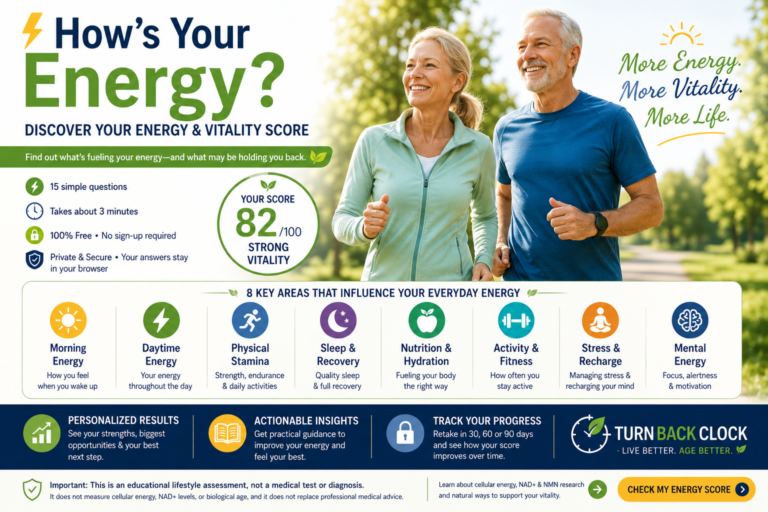
Do you wake up refreshed? Have enough energy to get through the day? Recover well after activity? Discover the lifestyle factors that may be supporting — or draining — your everyday vitality.
The TurnBackClock Energy & Vitality Score is an educational lifestyle assessment based on self-reported energy, sleep, activity, nutrition, stress, recovery and other everyday factors. It is not a medical test.
Why Everyday Energy Matters
Feeling energetic helps you stay active, enjoy life and support healthy aging.
Everyday tiredness can have many causes. According to the National Institute on Aging, fatigue can be a normal response to physical activity, emotional stress or insufficient sleep. Persistent fatigue can also have medical or psychological causes.
If you have unexplained or persistent fatigue lasting several weeks, or a significant change from your normal energy level, speak with a healthcare professional rather than relying on this assessment.
Source: National Institute on Aging — Fatigue in Older Adults


📈 TRACK YOUR PROGRESS
Your previous self-reported Energy & Vitality Score (stored only in this browser):
Previous: — | Current: —
Your self-reported lifestyle and vitality score has changed. This does not represent a medical improvement.
⚡ Your Energy & Vitality Score
Your score reflects your self-reported energy, sleep, recovery, activity, nutrition, stress and overall vitality.
This is an educational lifestyle score — not a medical measurement.
Your Energy Profile
✨ What’s Working Well
🌱 Your Biggest Opportunities
A Quick Note About Low Energy
Everyone feels tired from time to time. However, persistent or unexplained fatigue can sometimes have causes that aren’t simply related to lifestyle.
According to the National Institute on Aging, ongoing fatigue can be associated with sleep problems, stress, medications and a range of health conditions.
If you have unexplained or persistent fatigue lasting several weeks, or notice a significant change in your normal energy, consider speaking with a healthcare professional.
Source: National Institute on Aging — Fatigue in Older Adults
🔬 Curious About Cellular Energy?
Your everyday energy and your cells’ energy are related — but they aren’t the same thing.
Inside your cells, NAD+ is an important molecule involved in energy metabolism and many other biological processes.
What is NAD+?
NAD+ (nicotinamide adenine dinucleotide) is a coenzyme involved in numerous cellular reactions, including energy metabolism and cellular signaling.
What is NMN?
NMN (nicotinamide mononucleotide) is a precursor involved in the body’s production of NAD+.
Why are scientists interested?
Research suggests that NAD+ metabolism changes with age, and scientists are investigating whether NAD+ precursors such as NMN and NR could influence aspects of healthy aging.
Human studies have shown that oral NMN can increase NAD+-related biomarkers, but whether this translates into broad improvements in energy, healthspan or aging remains an active research question.
Researchers are studying whether increasing NAD+ availability through precursors such as NMN or NR could influence aspects of healthy aging. Human research is promising in some areas but remains incomplete. A 2026 systematic review found that oral NR and NMN generally demonstrated biochemical target engagement in humans, but effects on functional, metabolic, vascular and other healthspan outcomes were heterogeneous and often null or endpoint-specific. Research is active and promising, but scientists have not yet established that NAD+ supplementation reliably produces broad anti-aging or vitality benefits in humans.
One 2024 randomized, double-blind, placebo-controlled study in 60 older adults investigated 250 mg/day NMN for 12 weeks. The study reported increased blood NAD+ and NAD-related metabolites and some secondary findings involving walking speed and sleep quality, but its primary stepping-test outcome did not show a significant difference between NMN and placebo. Authors included employees of Meiji Holdings.
Explore the Science of Healthy Energy
Cellular Energy & Aging
Learn how cells produce energy and why NAD+ has attracted interest in longevity research.
Explore →NAD+ & NMN Explained
Discover what NAD+ and NMN are, what human research has found so far, and what remains uncertain.
Explore →Natural Ways to Support Energy
Explore evidence-based lifestyle approaches involving sleep, movement, nutrition and stress management.
Explore →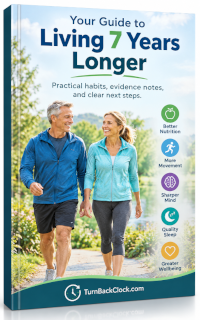
Get Your Free Guide + Ongoing Help
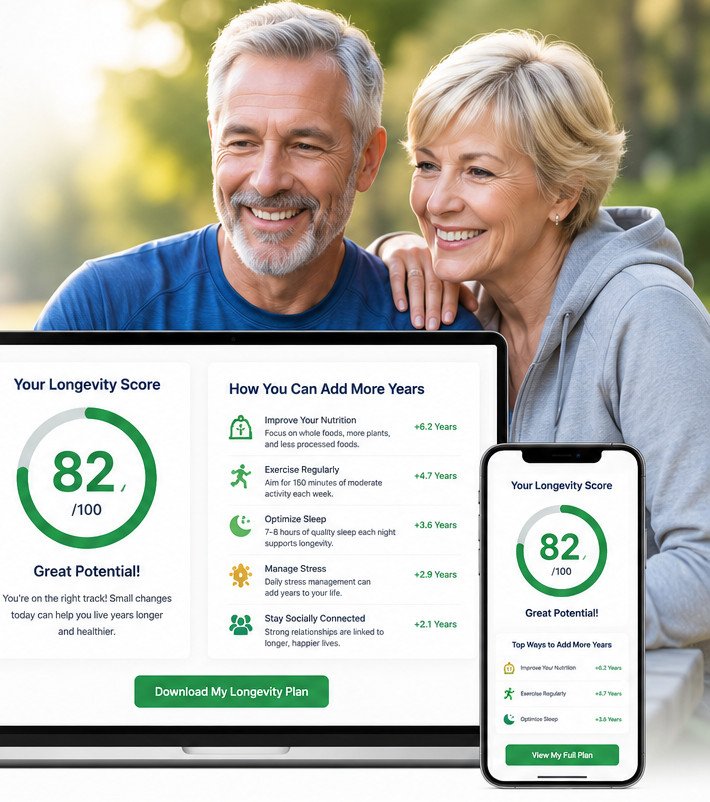
Instantly receive “Your Guide to Living 7 Years Longer” — tailored for your energy score:
- The 5 habits with the strongest evidence for adding years & boosting daily energy
- Clinically studied NMN & NR dose ranges
- Honest side-by-side comparison of 4 NMN products
- Simple next steps to improve your Energy & Vitality Score this week
You’ll also join our short email series with extra tips to put the guide into action.
We respect your privacy. You can unsubscribe anytime. No spam.
Explore More TurnBackClock Tools
🧬 How Young Is Your Body?
Biological Age Calculator — Discover your estimated biological age based on lifestyle and other factors.
Try it →🌱 How Well Are You Aging?
Healthy Aging Score — See how you’re doing across key areas of healthy aging.
Try it →⏳ How Long Might You Live?
Longevity Calculator — Explore your estimated lifespan based on lifestyle factors.
Try it →Come back in 30, 60 or 90 days and see whether your Energy & Vitality Score has changed.
Research & Further Reading
- National Institute on Aging — Fatigue in Older Adults
- PubMed — The Safety and Antiaging Effects of Nicotinamide Mononucleotide in Human Clinical Trials: an Update
- PubMed — Dietary Supplementation With NAD+-Boosting Compounds in Humans: Current Knowledge and Future Directions
- PubMed — Preclinical and clinical evidence of NAD+ precursors in health, disease, and ageing
- PubMed — NAD+ supplementation for anti-aging and wellness: A PRISMA-guided systematic review of preclinical and clinical evidence
- PubMed — Ingestion of β-nicotinamide mononucleotide increased blood NAD levels, maintained walking speed, and improved sleep quality in older adults…
These sources provide background information. They did not create or validate the TurnBackClock Energy & Vitality Score. The scoring model is our own educational model.