
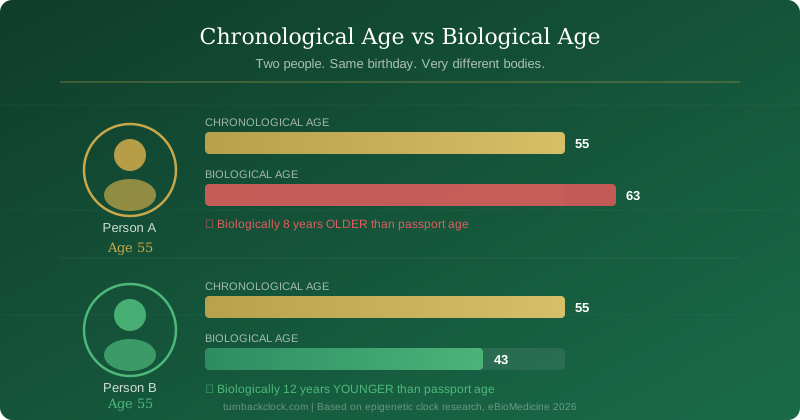
You’ve probably met someone in their 60s who looks and moves like they’re 45. And you’ve almost certainly met someone in their 40s who seems worn out, sluggish, and older than their years. Same number on the passport. Completely different bodies.
That gap has a name: biological age.
Understanding biological age is one of the most important shifts you can make in how you think about your health — because it turns out the year you were born tells us surprisingly little about how long or how well you’ll live.
Chronological Age vs Biological Age: What’s the Difference?
Your chronological age is simply the number of years since you were born. It moves at exactly the same speed for everyone — one year per year, no exceptions.
Your biological age is something different. It reflects the actual physical condition of your cells, tissues, and organs. It captures how fast — or how slowly — your body is wearing down at the molecular level.
Two people born on the same day can have biological ages that differ by a decade or more. One may have the cellular profile of a 55-year-old. The other, despite the same birthday, may have the cellular profile of a 45-year-old.
That 10-year gap is not trivial. It represents a meaningfully different risk of heart disease, cognitive decline, cancer, and premature death.
How Is Biological Age Actually Measured?
This is where things get genuinely fascinating — and where science has made enormous strides in the last decade.
Epigenetic Clocks
The most accurate way to measure biological age is through epigenetic clocks — tools that analyse chemical changes on your DNA called methylation patterns.
Think of DNA methylation like tiny sticky notes attached to your genes. As you age, these notes change in predictable ways. By reading thousands of these methylation patterns, scientists can estimate how old your cells are behaving — often more accurately than any other method.
The most well-known epigenetic clocks include:
Horvath Clock (2013) — the original landmark clock, trained on data from multiple tissue types
PhenoAge — developed by Dr Morgan Levine at Yale, designed to predict disease and mortality risk
DunedinPACE — measures the pace of aging, not just the current age. Think of it as a speedometer for how fast you’re aging right now
A major 2025 longitudinal study published in eBioMedicine confirmed that DunedinPACE and similar epigenetic tools successfully predict cardiovascular risk, mortality, and disease vulnerability years before symptoms appear.¹
And in early 2026, a study published in Nature Aging found that people whose epigenetic clock scores accelerated over time had significantly higher mortality risk — independent of all other known risk factors.²
Other Ways to Measure Biological Age
Epigenetic testing is the gold standard, but not the only option:
Telomere length testing — telomeres are protective caps on chromosomes that shorten as cells divide. Shorter telomeres generally indicate older biological age
Blood biomarker panels — measuring inflammatory markers, metabolic indicators, and organ function to build an overall biological age estimate
VO2 max testing — your aerobic capacity is one of the strongest single predictors of longevity and correlates closely with biological age
What Accelerates Biological Aging?
The same 2025 eBioMedicine study identified the key drivers of accelerated biological aging with striking clarity.¹ The factors pushing your biological age upward fastest include:
- smoking — the most powerful accelerant on the list
- High BMI — excess body fat drives systemic inflammation
- Poor blood sugar control — elevated glucose directly damages cells.
- High blood pressure — creates chronic vascular stress.
- Physical inactivity — sitting is genuinely aging you faster.
- Chronic stress — sustained cortisol elevation accelerates cellular aging .
- Poor sleep — disrupts the cellular repair processes that normally run overnight
What’s striking is how much of this list is modifiable. These are not fixed genetic sentences. They are lifestyle variables — which means they can be changed.
What Slows Biological Aging?
The encouraging side of the same research is equally clear. Factors consistently associated with a slower biological age include:
- Regular physical activity — particularly a combination of aerobic and resistance training.
- A whole-food, anti-inflammatory diet — especially Mediterranean-style eating patterns.
- Healthy blood glucose levels — even in people without diabetes, keeping glucose steady matters.
- Not smoking — or quitting as early as possible.
- Quality sleep — 7 to 8 hours in a consistent pattern.
- Stress management — meditation, community, purpose, and psychological safety all measurably affect biological age
A 2026 review published in eBioMedicine confirmed that these modifiable factors — taken together — can meaningfully shift epigenetic age measurements.¹ This is not theoretical. It has been measured in human tissue.
Can You Reverse Your Biological Age?
This is the question everyone asks — and the honest answer is: the evidence is promising, but still emerging.
Several intervention studies have reported reductions in measured biological age following lifestyle and supplement interventions. The most cited is a 2021 study by Dr Greg Fahy published in Aging Cell, which reported a mean reduction of 1.96 biological years in a small group of participants following a combined protocol of diet, exercise, sleep, and targeted supplementation.
More recent research is exploring whether compounds like NMN, NAD+ precursors, and senolytics (drugs that clear damaged cells) can move the needle further.
The science is not yet settled. But what is well-established is this: the lifestyle factors that slow biological aging are consistent, measurable, and available to everyone.
Why Your Biological Age Is More Important Than Your Birthday
Your chronological age determines when you can get a senior’s discount. Your biological age determines your actual risk of disease, your energy levels, your cognitive sharpness, and in all likelihood, how long you’ll live.
A 2023 review in Cell concluded that biological age biomarkers are now reliable enough to identify longevity interventions and evaluate whether they actually work.³
The goal of longevity science — and of everything we write about at Turn Back Clock — is not simply to add years to your life. It is to keep your biological age as far behind your chronological age as possible, for as long as possible.
That gap between the two numbers? That is where health lives.
How to Find Out Your Own Biological Age
You have several options, ranging from free estimates to clinical-grade testing:
Free estimate — use our Life Expectancy Calculator to get a lifestyle-based biological age estimate in 2 minutes
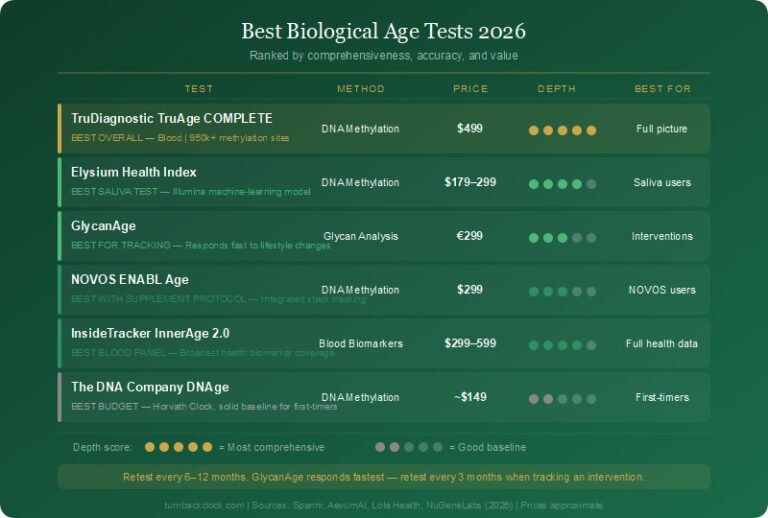
At-home epigenetic test — companies like TruAge, GlycanAge, and DoNotAge offer mail-in biological age tests from $150–$300
Full blood panel — services like InsideTracker or Viome analyse dozens of biomarkers to calculate a comprehensive biological age score
Key Takeaways
- Biological age measures how old your cells actually are, independent of your birthday.
- Epigenetic clocks — tools that read DNA methylation patterns — are the most accurate way to measure it.
- Smoking, inactivity, poor diet, high blood sugar, and chronic stress all accelerate biological aging.
- Exercise, whole-food diet, good sleep, and stress management measurably slow it
Your biological age is largely within your control — and that is the most important thing to understand
At Turn Back Clock, we focus on the science of internal anti-aging — what you put in your body, how you live, and how to measure progress.
References
eBioMedicine / The Lancet. Epigenetic clocks: advancing biological age measures towards meaningful clinical use. February 2026. https://www.thelancet.com/journals/ebiom/article/PIIS2352-3964(26)00056-3/fulltext
Kuo et al. Longitudinal changes in epigenetic clocks predict survival in the InCHIANTI cohort. Nature Aging, March 2026. https://www.nature.com/articles/s43587-026-01066-6
Moqri M et al. Biomarkers of aging for the identification and evaluation of longevity interventions. Cell, 2023. https://doi.org/10.1016/j.cell.2023.08.003