“I daily have foot and ankle swelling. It’s all gone by the morning so my primary care physician says not to worry, but it still bothers me.” That was a 61-year-old writing in an online ageing forum, and dozens of people in their sixties and seventies chimed in with the same story: socks that leave deep grooves by teatime, shoes that feel a size smaller at night. If you have swollen ankles after 60, you are in very good company, and the good news is that there is a lot you can do about it.
This is a calm, practical guide. We will look at why fluid gathers around the ankles as the day goes on, the simple habits readers say made the biggest difference, how to make compression socks less of a battle, which common medicines can be behind it, and the signs that mean it is time to get checked rather than wait it out.
Why your ankles puff up as the day goes on
Your blood travels down to your feet easily, helped by gravity. Getting it back up to the heart is harder work. The veins in your legs have tiny one-way valves, and every time your calf muscles tighten, they squeeze those veins and push blood and fluid upward. Doctors often call the calf your “second heart” for exactly this reason.
With age, a few things make that return trip slower. The valves can get a little leaky, the calf muscles may be weaker, and many of us sit for longer stretches than we did when working. Some fluid then seeps out of the small blood vessels into the tissue around the ankles, where gravity keeps it. Overnight, lying flat, the fluid drifts back and is cleared, which is why the swelling has often gone by morning.
Warm weather, a long flight or car ride, a salty meal and standing still in a queue can all make it worse. None of that means something is seriously wrong, but it does mean your legs could use a little help.
The 2-minute heel raise routine that helped one 73-year-old
One reader in a forum for people over seventy wrote that compression socks had been “too much trouble putting on”, so she gave up on them. Her doctor suggested something simpler: “lift my heels up and down 20 times, repeating 2-3 times daily.” Her report: “My swelling started to go down in just 10 days.” Another reader, aged 76, said she was saving the post for reference.
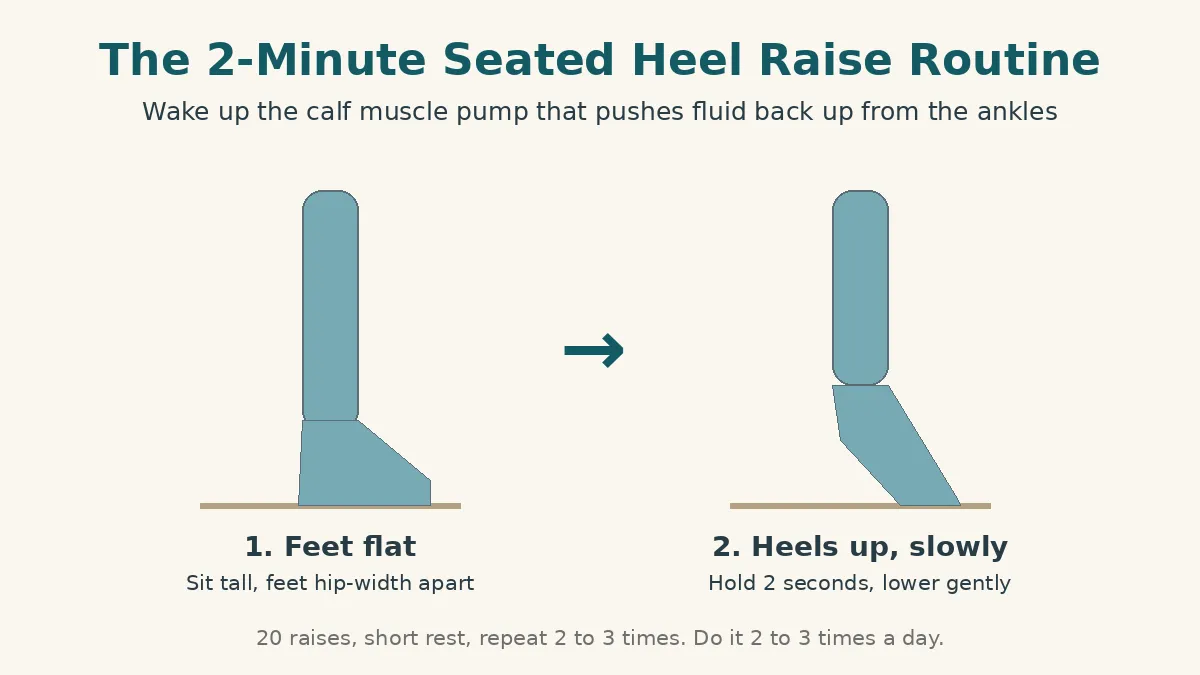
Heel raises work because they switch on the calf pump. You can do them sitting in your favourite chair, which makes them easy to fit around the day:
- Sit tall. Sit near the front of a sturdy chair with both feet flat on the floor, about hip-width apart. Rest your hands on your thighs or the chair.
- Lift your heels. Press through the balls of your feet and slowly lift both heels as high as is comfortable. Hold for about two seconds.
- Lower gently. Lower your heels slowly back to the floor. That is one raise.
- Repeat 20 times. Do 20 slow raises, rest for a few breaths, then do another set or two. The whole routine takes about two minutes.
- Make it a habit. Repeat two or three times a day, for example after breakfast, mid-afternoon and during the evening news.
If you already enjoy chair exercises, this slots in neatly at the end. Ankle circles, drawing the alphabet with your toes, and pointing and flexing your feet give the same pump a gentle workout too. Stop if anything hurts, and go easy at first if your feet or knees are stiff.
Other everyday habits that ease ankle swelling
- Put your legs up the wall. Several readers swore by “lying on my back on the floor and putting my feet up against the wall” for 10 to 15 minutes in the evening. If getting down to the floor is tricky, lie on the bed or sofa with your feet on a couple of pillows, a little higher than your heart.
- Keep moving little and often. Walking is the calf pump in action. Even a five-minute stroll every hour or so helps. Swimming and water walking are especially kind, because the gentle pressure of the water pushes fluid upward while you move.
- Break up long sitting. Set a timer while reading or watching television, and stand, march on the spot or do a set of heel raises when it rings. On long journeys, stop for a walk or move your feet often.
- Go easy on salt. Salt makes the body hold on to water. Much of it hides in bread, soups, ready meals, cured meats and sauces, so check labels and season with herbs, lemon or pepper instead.
- Wear comfortable, supportive shoes that adjust with laces or straps as feet swell, and avoid tight sock tops that dig in.
Compression socks: choosing them and actually getting them on
Compression socks gently squeeze the lower leg, tightest at the ankle and easing off higher up, so fluid has less room to collect. Many readers found them the single most helpful thing, with one firm piece of advice: “Compression socks every day, don’t wear them to bed, and get properly fitted.”
- Start mild. Light support (often labelled 15 to 20 mmHg) is widely sold. Firmer grades should be chosen with your doctor or a fitter.
- Get measured. A pharmacist or medical supply shop can measure your ankle and calf, ideally in the morning before swelling builds. The right size is far easier to put on and much more comfortable.
- Put them on early. First thing in the morning, before the swelling starts, is easiest. Take them off at bedtime.
- Use a sock donner. A simple frame or slippery sleeve that holds the sock open while you step in. One 76-year-old reader said she relies on hers every day.
- Try rubber-palmed gloves. The same reader uses “garden gloves with rubber palms to adjust the socks.” Ordinary rubber dishwashing gloves work too, giving grip to smooth the fabric up the leg without pinching.
- Check with your doctor first if you have poor circulation in the legs, diabetes with numb feet, or heart failure, because compression is not right for everyone.
Small, steady habits like these add up. If you like simple, practical tips for staying active and independent, our free healthy ageing guide gathers many of them in one easy read.
Could a medicine be behind your swollen ankles after 60?
This came up again and again. “My ankles swelled to balloon size on amlodipine. My feet could not fit into my shoes,” one reader wrote. Another said, “We’re switching my BP medication. Going off Amlodipine,” and planned further checks if the swelling stayed.
Amlodipine and other calcium-channel blockers, such as nifedipine and felodipine, are among the most common medicine causes of ankle swelling, especially at higher doses. Others include some diabetes medicines (for example pioglitazone), anti-inflammatory pain relievers such as ibuprofen and naproxen, steroid tablets, some hormone treatments and certain nerve-pain medicines like gabapentin and pregabalin.
Please do not stop any of these on your own. Write down when the swelling started and any medicine changes around that time, then ask your doctor or pharmacist: “Could this be causing my ankle swelling, and is there a lower dose or a different option we could try?” Often there is.
When swelling needs a check-up soon
Evening swelling that is the same on both sides and gone by morning is usually not urgent, but it still deserves a mention at your next visit. Your doctor may look at your heart, kidneys, liver, thyroid and leg veins, which is a sensible check-up rather than a cause for worry. Contact your doctor soon if you notice any of these:
- Swelling in one leg only, or one side much bigger than the other
- Pain, warmth or redness in the calf or leg
- Shortness of breath, a new cough, or needing more pillows to breathe comfortably at night
- Sudden weight gain, such as a kilo or more (2 to 3 pounds) in a day or two
- Swelling that leaves a dent that stays when you press the skin with a finger
- Swelling that no longer goes down overnight, or skin that becomes shiny, darker, cracked or weepy
If swelling comes on suddenly with chest pain, trouble breathing or feeling faint, call emergency services straight away.
A calm way forward
The reader who started this conversation was right on both counts. Her doctor was probably correct that evening swelling which clears overnight is usually not serious, and she was also right not to simply ignore something that bothered her. A couple of minutes of heel raises, legs up for a while in the evening, regular walks, a little less salt and well-fitted socks have helped many people in their sixties and seventies get back into their favourite shoes. Information from the US National Institutes of Health, the UK NHS and the American Heart Association points in the same practical direction.
This article is for general information only and is not medical advice. Please speak with your doctor or pharmacist about your own health, especially before starting, stopping or changing any medicine.
Get the Free Guide
Instantly receive Your Guide to Living 7 Years Longer — practical habits, evidence notes, and clear next steps. Soft mentions of our free longevity tools are inside. No miracle promises.
We’ll never share your email. You can unsubscribe anytime.
Frequently asked questions
Is it normal to have swollen ankles in the evening that are gone by morning?
It is very common after 60. Fluid drifts down to the feet and ankles during a day of sitting and standing, then moves back while you lie flat overnight. If both ankles swell about the same, it clears by morning and you feel well otherwise, it is often linked to everyday things like long sitting, heat, salt or a medicine. It is still worth mentioning to your doctor, so they can check your heart, kidneys, veins and medicine list.
Can amlodipine cause swollen ankles?
Yes. Ankle swelling is one of the best-known side effects of amlodipine and other calcium-channel blockers used for blood pressure, and it is more likely at higher doses. Please do not stop the medicine on your own. Ask your doctor whether a lower dose, a different medicine or a combination might suit you better.
Do compression socks help swollen ankles?
For many people they do, by gently squeezing the lower leg so fluid has less room to pool. Put them on in the morning before swelling builds, take them off at bedtime, and ask to be measured so the size and pressure are right. Check with your doctor first if you have poor circulation in your legs, diabetes with numb feet, or heart failure.
When should swollen ankles be checked by a doctor?
Get checked soon if only one leg swells, if the leg is painful, warm or red, if you feel short of breath or cannot lie flat, if you gain weight quickly over a few days, or if pressing the skin leaves a dent that stays. Sudden swelling with chest pain or trouble breathing needs emergency care right away.