
Published by Turn Back Clock | Category: Biological Age
You can’t improve what you can’t measure. That principle, borrowed from management science, turns out to be one of the most useful ideas in longevity — because biological aging is now measurable in ways that were science fiction a decade ago.
Biological age tests tell you how old your cells are actually behaving, independent of your birthday. Two people born the same year can have biological ages that differ by a decade or more, depending on how they live. The tests we now have can capture that gap with remarkable precision.
But not all biological age tests are created equal. The market in 2026 has matured significantly, and there are now meaningful differences in methodology, accuracy, depth of reporting, and price. This guide cuts through the noise.
How Biological Age Tests Work: The Three Methods
Before comparing specific products, it is worth understanding the main approaches:
1. DNA Methylation (Epigenetic Clocks) — Gold Standard
As you age, chemical tags called methyl groups attach to and detach from specific sites on your DNA in predictable patterns. By reading thousands of these methylation markers, epigenetic clocks can estimate how old your cells are behaving with remarkable accuracy.
Key clocks used in commercial tests include the Horvath Clock (the original), PhenoAge (predicts disease risk), GrimAge (predicts mortality risk), and DunedinPACE (measures the speed at which you are aging right now). Tests using multiple clocks give the most comprehensive picture.
2. Glycan Analysis — Immune System Focus
IgG glycans are sugar molecules attached to antibodies in your immune system. Their composition changes with age and inflammation. Glycan analysis provides a window into your immune system’s biological age and responds relatively quickly to lifestyle changes — making it useful for tracking interventions over months rather than years.
3. Blood Biomarker Panels — Broadest Coverage
Services like InsideTracker analyse dozens of blood markers — metabolic, hormonal, inflammatory, and organ-function indicators — to build a composite biological age estimate. Less precise than epigenetic clocks on aging specifically, but broader in health coverage and actionability.
The Tests: Ranked and Reviewed
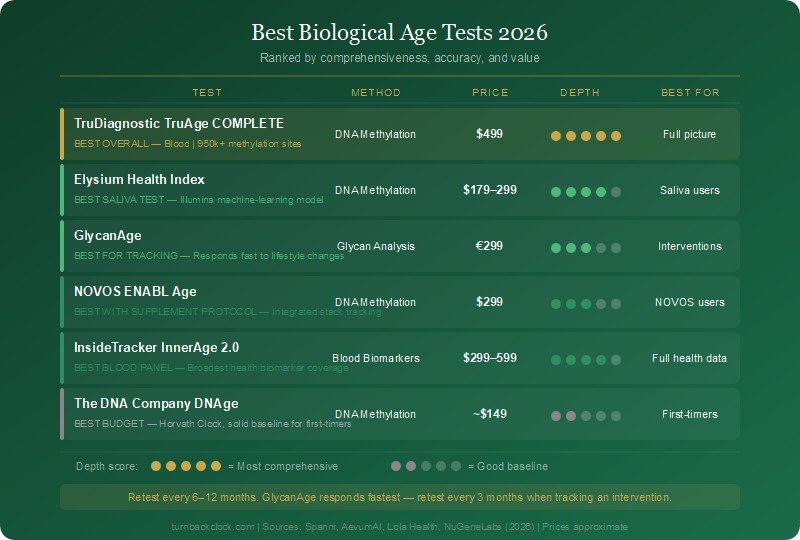
1. TruDiagnostic TruAge COMPLETE — Best Overall
Price: ~99 (US) / £380 (UK) | Method: DNA methylation | Sample: Blood (finger prick)
TruAge COMPLETE is widely regarded as the most technically advanced consumer biological age test available in 2026. It analyses over 950,000 DNA methylation markers — compared to around 2,000 in basic methylation tests — and runs multiple validated aging algorithms simultaneously.
What you get:
- Overall biological age based on multiple epigenetic clocks
- DunedinPACE score — how fast you are aging right now (the most actionable single number)
- SYMPHONYAge — organ-specific biological age scores for your brain, liver, heart, kidneys, and 7 other systems
- Telomere length measurement
- Immune age assessment
Best for: Anyone serious about tracking their biological aging comprehensively. The organ-level scores are particularly powerful — you may find your heart is 5 years younger than your liver, which points to specific interventions.
Limitation: Price. At ~99 per test, retesting twice a year adds up quickly.
2. Elysium Health Index — Best Saliva Test
Price: ~99 single / 79 with subscription | Method: DNA methylation | Sample: Saliva
Elysium Health is one of the most credible brands in consumer longevity, having been founded with significant scientific advisory involvement. The Index test uses a proprietary machine-learning methylation model developed with Illumina, one of the world’s leading genomics companies.
What you get:
- An overall biological age estimate
- A biological age score for multiple body systems
- Longitudinal tracking via their app if you retest
Best for: Users who prefer saliva collection over blood, want strong brand credibility, and value clean longitudinal tracking.
Limitation: Uses an undisclosed number of methylation markers vs TruAge’s 950,000+, and saliva is considered slightly less accurate than blood for epigenetic analysis.
3. GlycanAge — Best for Tracking Lifestyle Interventions
Price: €299 (single) / €199 each for twin pack | Method: IgG glycan analysis | Sample: Blood spot
GlycanAge takes a fundamentally different approach to biological age testing. Rather than measuring DNA methylation, it analyses the composition of IgG glycans — sugar molecules attached to immune antibodies. The test was developed by Professor Gordan Lauc at Genos, a Croatian glycobiology laboratory with over 15 years of glycan research.
What makes GlycanAge distinctive is its responsiveness. While epigenetic clock scores typically take months or years to shift meaningfully with lifestyle changes, glycan profiles can change in weeks. This makes GlycanAge particularly useful for testing whether specific interventions — a new exercise routine, a diet change, a supplement protocol — are working.
Best for: Anyone actively testing interventions who wants faster feedback. The twin-pack model (baseline + follow-up) is smart product design for this purpose. Includes a one-on-one consultation with a healthspan physician.
Limitation: Measures only one type of biomarker. Best used as a complement to an epigenetic test, not a substitute.
4. NOVOS ENABL Age — Best Integration with Supplement Protocol
Price: ~99 | Method: DNA methylation (DunedinPACE + immune age) | Sample: Blood
NOVOS — the longevity supplement company whose formulas were developed by Harvard and MIT scientists — launched their own biological age test integrated with their supplement ecosystem. The ENABL Age test uses DunedinPACE (pace of aging) alongside immune age scoring.
Best for: People already using NOVOS supplements who want to track whether their protocol is moving the needle. The integration between test results and supplement recommendations is genuinely useful.
Limitation: Less comprehensive than TruAge COMPLETE. The integration with NOVOS products means there is an inherent commercial interest in the recommendations.
5. InsideTracker InnerAge 2.0 — Best Blood Panel Option
Price: ~99–99 depending on panel | Method: Blood biomarkers | Sample: Venous blood draw (clinic visit required)
InsideTracker takes a different approach from the methylation tests. Instead of analysing DNA, it measures dozens of blood biomarkers — including inflammatory markers, metabolic indicators, hormonal levels, and organ function — to produce a composite biological age estimate.
Best for: People who want the broadest health picture, not just a biological age number. InsideTracker’s actionable recommendations based on your specific biomarker pattern are particularly well-developed. Requires a clinic visit for blood draw.
Limitation: The biological age number is less scientifically validated as an aging measure than epigenetic clocks. The value is really in the comprehensive biomarker panel and action recommendations.
6. The DNA Company DNAge — Best Budget Option
Price: ~49 | Method: DNA methylation (Horvath Clock) | Sample: Saliva
For those who want to get started with biological age testing without a large investment, DNAge offers a solid Horvath Clock-based methylation test at an accessible price point. It delivers roughly 80% of the value of premium tests for about 30% of the cost.
Best for: First-time testers, budget-conscious users, or those who want a baseline before committing to a more expensive test.
Limitation: Uses the original Horvath Clock (~2,000 methylation sites) rather than newer multi-clock models. Less detailed reporting than premium options.
Quick Comparison Summary
- Best overall: TruDiagnostic TruAge COMPLETE (99)
- Best saliva test: Elysium Health Index (99)
- Best for tracking interventions: GlycanAge (€299)
- Best with supplement integration: NOVOS ENABL Age (99)
- Best comprehensive blood panel: InsideTracker InnerAge 2.0 (99–99)
- Best budget option: The DNA Company DNAge (~49)
How Often Should You Test?
For most people, retesting every 6–12 months is sufficient. More frequent testing often reflects biological noise rather than meaningful change. Retesting is most valuable when paired with a structured intervention — a new exercise protocol, dietary change, supplement regimen, or sleep optimisation programme. GlycanAge can be retested more frequently (every 3 months) due to its faster response to lifestyle changes.
A Note on Interpreting Results
Finding out that your biological age is older than you expected is not a death sentence. It is an actionable data point. Multiple studies have confirmed that the same lifestyle factors that improve biological age test scores — exercise, diet quality, sleep, stress management, and targeted supplementation — are associated with genuine reductions in disease risk.
The goal is not a single test. It is tracking your trajectory over time — and watching your biological age diverge further from your chronological age as you implement changes.
Key Takeaways
- DNA methylation (epigenetic clock) tests are the gold standard for biological age measurement
- TruDiagnostic TruAge COMPLETE is the most comprehensive consumer test available in 2026, with 950,000+ methylation markers and organ-level scoring
- GlycanAge responds fastest to lifestyle changes — ideal for testing specific interventions
- Elysium Index is the best saliva-based option for those who prefer it
- DNAge at ~49 is the best entry point for first-time testers
- Test every 6–12 months, ideally paired with a structured intervention you are tracking
- A high biological age score is a call to action, not a verdict
Start with our free Life Expectancy Calculator for an instant lifestyle-based estimate before investing in a clinical test.
References
1. Mindbodygreen. Best Biological Age Tests of 2026 For Longevity. https://www.mindbodygreen.com/articles/best-biological-age-test
2. Spannr. The Best Biological Age Tests of 2026: An Independent Comparison. https://app.spannr.com/articles/top-epigenetic-age-tests
3. AevumAI. Best Biological Age Test 2026: GlycanAge, TruDiagnostic & More Compared. https://theaevumai.com/post/biological-age-test-2026
4. Lola Health. Best Biological Age Tests – UK Guide 2026. https://lolahealth.com/blogs/longevity/best-biological-age-tests
5. NuGeneLabs. Biological Age Tests Compared: 6 Tests, 3 Methods, Side-by-Side. https://nugenelabs.com/blogs/health-insights/biological-age-tests-compared
6. Simply Anti-Aging. TruAge Review 2026. https://simplyantiaging.com/truage-test-review/
© 2026 Turn Back Clock · turnbackclock.com · For informational purposes only. Not medical advice.