Short answer: night leg cramps after 60 are very common, and for most people they are more of a sleep thief than a sign of something serious. A gentle calf stretch before bed, flexing your foot the moment a cramp grabs, and drinking more of your fluids earlier in the day are simple things you can try tonight. If cramps keep waking you up, it is worth a chat with your doctor about your medicines and a few basic checks. This guide is educational only, not personal medical advice.
“They have been waking me up constantly lately. I’m looking for natural solutions if possible!” That is how one woman in her sixties put it in an online group for women over 60, and the dozens of replies that followed showed just how many people know that sudden, rock-hard knot in the calf at 3 a.m. You are in good company, and there is a fair amount you can do.

Why night leg cramps after 60 are so common
Up to six in ten adults say they have had nighttime leg cramps, and they become more frequent with age. Doctors still are not completely sure why they happen. A review in American Family Physician suggests the main drivers are probably tired muscles and changes in the nerves that control them, rather than a simple shortage of a mineral (PMID 22963024).
A few everyday things seem to make cramps more likely:
- Long hours sitting with knees bent, then lying down with toes pointed under heavy bedding, which leaves the calf in a shortened position all night.
- Muscles that are less used or, the opposite, a day of unusual effort such as gardening, a long walk, or lots of stairs.
- Certain medicines and health conditions, which we cover below, are worth talking through with a doctor.
Get the Free Guide
Instantly receive Your Guide to Living 7 Years Longer — practical habits, evidence notes, and clear next steps. No miracle promises.
We’ll never share your email. You can unsubscribe anytime.
When a cramp hits: what to do in the moment
Most cramps ease within a minute or two, even though it can feel much longer. These moves are safe for most people and are what clinicians usually suggest first:
- Flex your foot. Straighten your leg and pull your toes back toward your shin. If you can, loop a towel or the bed sheet around the ball of your foot and draw it gently toward you.
- Stand and press your heel down. If you are steady enough, stand up holding the bedside table or a wall and put weight through the cramping leg with the heel flat. Turn on a light first so you do not trip.
- Rub it out. Firm, slow massage of the calf can help the muscle let go.
- Walk a few steps once the worst has passed, and add gentle warmth such as a warm shower if the muscle stays sore. If you have reduced feeling in your feet, check that anything warm is not too hot.
A three-minute bedtime calf stretch
This is the part with the best research behind it. In a randomised trial of 80 adults over 55 with regular nighttime cramps, people who stretched their calves and hamstrings every night just before sleep had about one fewer cramp per night after six weeks, and the cramps they did have hurt less (Hallegraeff et al., 2012, PMID 22341378). The stretches took only a few minutes.
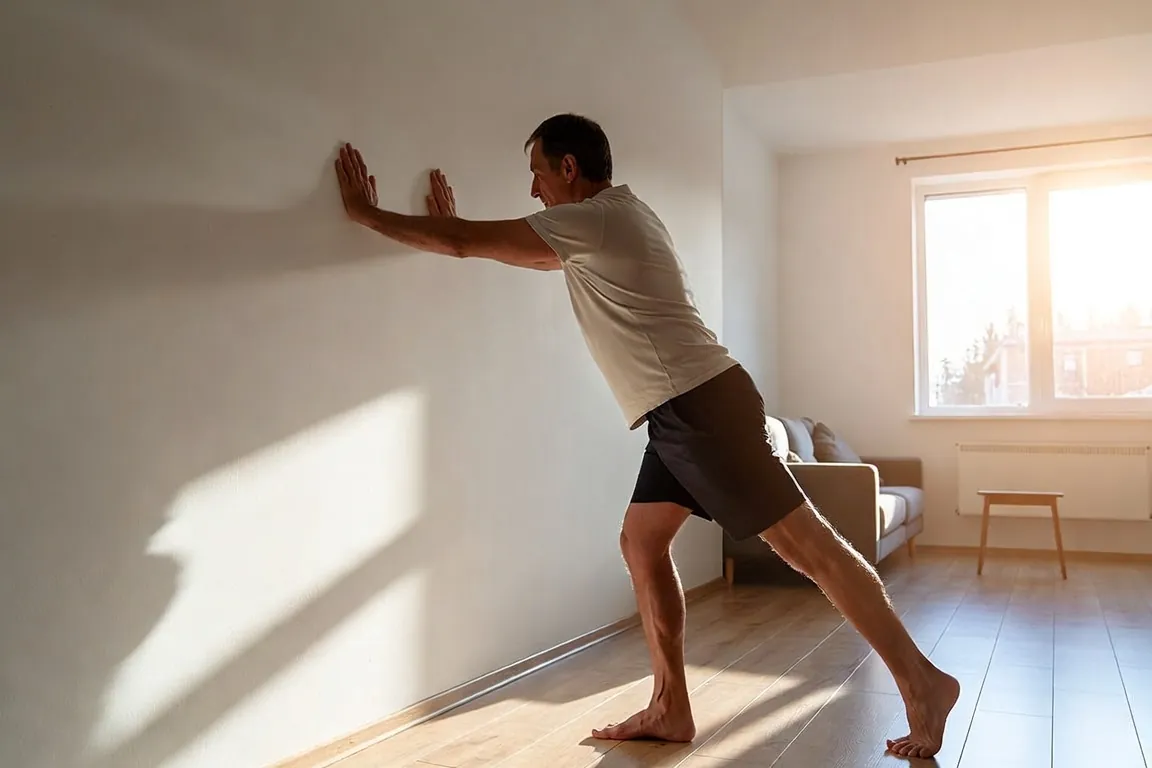
- Wall calf stretch. Stand facing a wall with both hands on it at shoulder height. Step one foot back, keep that heel on the floor and the back knee straight, and lean forward gently until you feel a stretch in the calf. Hold for 10 seconds, rest 10 seconds, and repeat 3 times on each leg.
- Bent-knee version. Do the same stretch with the back knee slightly bent. This reaches the lower part of the calf, near the Achilles tendon. Hold 10 seconds, 3 times each side.
- Seated hamstring stretch. Sit on the edge of a firm chair or the bed, straighten one leg out in front with the heel on the floor, and lean forward from the hips with a straight back until you feel a stretch behind the thigh. Hold 10 seconds, 3 times each side.
- Toe pulls in bed. Once you are lying down, point your toes up toward the ceiling and hold for a few seconds, a few times. It is a nice way to finish.
Move slowly, breathe normally, and stop if anything feels sharp. If balance is an issue, stand next to a counter, or do every stretch seated. For more gentle ideas, our 3 chair exercises for better balance and 5 simple chair exercises fit nicely into a bedtime routine.
Small daytime habits that may help
- Front-load your fluids. Drink steadily through the morning and afternoon, then ease off in the evening so you are not swapping cramps for bathroom trips. Thirst signals tend to fade with age, so a glass with each meal helps.
- Keep your legs moving. A daily walk and getting up every hour or so when sitting keep calf muscles used to work. Our guide on how many steps a day to aim for after 50 has realistic targets.
- Loosen the bedding. Untuck the sheet at the foot of the bed, or rest a pillow under the covers, so your toes are not pressed into a pointed position all night.
- Eat a varied diet. Foods such as bananas, potatoes, beans, leafy greens, yogurt and nuts are good everyday sources of potassium and magnesium. That is sensible for overall health, even though research does not show it stops cramps on its own.
- Track your nights. Jot down cramp nights alongside your stretching, walking and fluids in our free Health Habits Tracker. After two or three weeks you will have real notes to show your doctor, and you may spot your own pattern.
Things worth checking with your doctor
If cramps are frequent or new, a short appointment is a good idea. Common things a clinician may look at include:
- Your medicines. Water pills (diuretics), some cholesterol medicines such as statins, and several others have been linked with cramps in some people. The American Family Physician review lists naproxen, conjugated estrogens, raloxifene and teriparatide among them. Please do not stop or change any medicine on your own; your doctor or pharmacist can tell you whether a switch makes sense.
- Simple blood tests. Depending on your health, a doctor may check things like potassium, magnesium, calcium, kidney function, thyroid, blood sugar or iron. One person in the online thread found that a sleep study eventually led to treatment for low iron. That is a good reminder that what feels like a cramp is sometimes a different problem, such as restless legs.
- Circulation and nerves. Leg pain that comes on with walking and eases with rest, numbness, or burning feet are different from a simple cramp and deserve their own check.
What about magnesium?
Magnesium came up more than any other word in the online threads, and plenty of people take it. The best summary of the research so far, a Cochrane review, found that in older adults with ordinary leg cramps magnesium supplements were unlikely to make a meaningful difference compared with a placebo, and stomach upset such as diarrhoea was common (Garrison et al., 2020, PMID 32956536). The picture may be different for some groups, such as pregnant women, so the evidence is best described as mixed.
If you still want to try it, please talk to your doctor or pharmacist first. Magnesium can interact with some antibiotics and osteoporosis medicines, and people with kidney problems need extra care with it, according to the NIH Office of Dietary Supplements. We are not recommending any brand or product.
Is tonic water or quinine a good idea?
Many people grew up hearing that a glass of tonic water helps, because tonic contains a small amount of quinine. Quinine pills used to be prescribed for nighttime cramps, but the US Food and Drug Administration has warned that quinine should not be used to prevent or treat leg cramps. It has been linked to serious health risks, including dangerous drops in blood platelets, kidney problems and heart-rhythm changes, and its benefit for cramps does not outweigh those risks.
The amount in tonic water is far smaller than in a pill, and there is no good evidence that it prevents cramps either. It is also sugary. If you are thinking about quinine in any form, or you have had a reaction to tonic water before, check with your doctor or pharmacist first.
The same goes for pickle juice or a spoonful of mustard: some people swear by them, but there is little research on nighttime cramps, and pickle juice is very salty, which matters if you watch your blood pressure.
When to get checked sooner
- One calf is swollen, red, warm or tender, especially after a long trip or time in bed. Seek same-day medical care, because this needs ruling out a blood clot.
- Cramps come with muscle weakness, numbness, or changes in skin colour on the legs or feet.
- Cramps began after starting a new medicine.
- They are happening most nights and wrecking your sleep despite a few weeks of stretching.
Keep building better nights
Good sleep is one of the quiet foundations of healthy aging. Our guides on how to sleep better after 50 and how much sleep adults over 50 need pair well with the routine above. If you would like a wider snapshot of your habits, try the free Longevity Score Calculator or the Biological Age Calculator, keep your mind busy with Memory Gym 50+, or browse all our free health tools. Our free Guide to Living 7 Years Longer brings the bigger habits together in one place.
Questions people ask about nighttime leg cramps
Are night leg cramps a normal part of getting older?
They are very common after 60, and most of the time no single cause is found. Still, frequent or new cramps are worth mentioning to your doctor, mainly to review medicines and rule out other leg problems.
What is the quickest way to stop a cramp?
Straighten the leg and pull your toes toward your shin, or stand and press the heel down while holding something steady. Firm massage and a short walk usually help the muscle relax.
Does stretching before bed really help?
In one well-run trial of adults over 55, a few minutes of calf and hamstring stretches every night cut cramps by about one per night after six weeks. It is safe for most people and costs nothing.
Should I take magnesium for leg cramps?
Research in older adults has not shown a clear benefit, and it can upset the stomach or interact with some medicines. Talk to your doctor or pharmacist before trying it.
Is quinine safe for leg cramps?
The US FDA has warned against using quinine to prevent or treat leg cramps because of serious health risks. Ask your doctor about safer options.
Sources
- Allen RE, Kirby KA. Nocturnal leg cramps. Am Fam Physician. 2012;86(4):350-355. PMID 22963024
- Hallegraeff JM, et al. Stretching before sleep reduces the frequency and severity of nocturnal leg cramps in older adults: a randomised trial. J Physiother. 2012. PMID 22341378
- Garrison SR, et al. Magnesium for skeletal muscle cramps. Cochrane Database Syst Rev. 2020. PMID 32956536
- US FDA. Serious risks associated with using quinine to prevent or treat nocturnal leg cramps. fda.gov
- NIH Office of Dietary Supplements. Magnesium fact sheet. ods.od.nih.gov
Disclaimer: TurnBackClock.com shares educational information for adults 50+. Nothing here is medical advice, a diagnosis, or a treatment plan. Talk with your doctor or pharmacist about your own symptoms, medicines and any supplement before making changes.