What If You Are Much Younger Than Your Actual Age? Find Out Now!
Discover your estimated biological age in about 2 minutes.
Your chronological age tells you how many years you’ve been alive. Your lifestyle can tell a different story. Answer a few simple questions to get an estimated lifestyle-based biological age and discover the areas that may help you age more healthfully.
Free • No registration required • No medical diagnosis
Your Results
This is an educational estimate based on your answers — not a laboratory measurement of biological age.
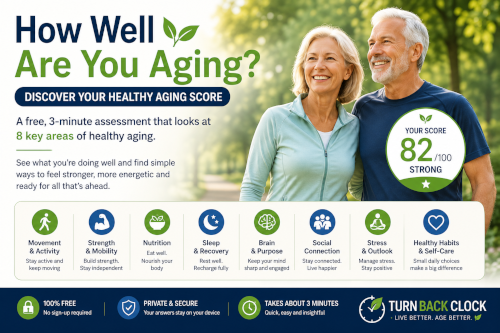
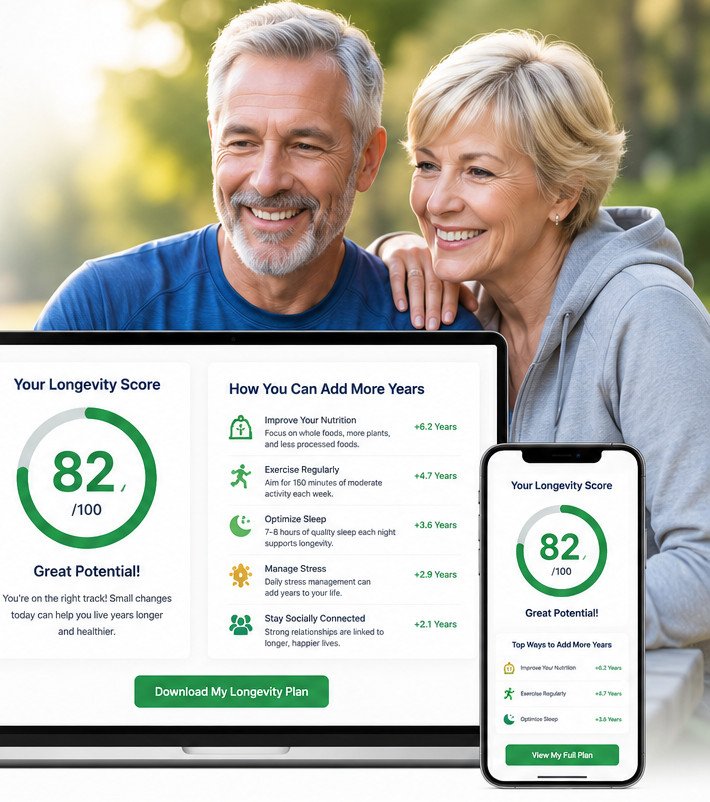
Your Healthy Aging Score
Your strongest areas
Your biggest opportunities
Your 3 Biggest Opportunities
Want to improve your biological age & healthy-aging scores?
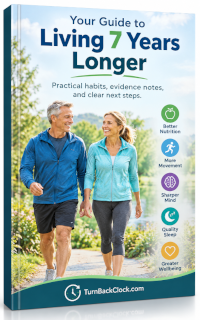
Get Your Free Guide + Ongoing Help
Instantly receive “Your Guide to Living 7 Years Longer” — the practical roadmap that covers:
- The 5 habits with the strongest evidence for adding years
- Clinically studied NMN & NR dose ranges
- Honest side-by-side comparison of 4 NMN products
- Simple next steps you can start this week
You’ll also join our short email series with extra tips, deeper explanations, and practical help so you can actually put the guide into action.
We respect your privacy. You can unsubscribe anytime.
Why Biological Age Is Interesting
Chronological age tells us how many years a person has lived. Biological aging research attempts to capture differences in how people age by examining physiological, molecular and functional characteristics.
Researchers have developed several approaches, including:
- Klemera-Doubal biological age
- PhenoAge
- Epigenetic clocks
- Biomarker-based aging measures
These approaches generally require biological measurements (blood chemistry, DNA methylation, etc.) that this calculator does not collect.
TurnBackClock’s calculator is a simplified lifestyle-based estimate designed for education and self-reflection. It is inspired by research showing that aging is influenced by multiple physiological, behavioral and lifestyle factors. It is not implementing PhenoAge, the Klemera-Doubal method, an epigenetic clock, or any laboratory biological-age algorithm.
How does this work?
Our calculator uses a simplified lifestyle-based scoring model (the TurnBackClock Lifestyle Aging Score) inspired by research showing that aging is influenced by multiple physiological, behavioral and lifestyle factors. It is designed for education and self-reflection rather than medical assessment.
Research Sources
- Levine ME, Lu AT, Quach A, et al. (2018). “An epigenetic biomarker of aging for lifespan and healthspan.” Aging. 10(4):573–591.
- Levine ME, Crimmins EM. (2018). “Is 60 the New 50? Examining Changes in Biological Age Over the Past Two Decades.” Demography. 55(2):387–402.
- Nakamura E, Miyao K. (2012). Related work on modeling the rate of senescence and biological age algorithms. The Journals of Gerontology: Series A.
- Dubina TL, Doubal VP. (related Klemera–Doubal method literature). Biological age as a measure of ageing.
- U.S. National Institute on Aging — resources on biomarkers of aging and biological aging research.
These studies inform the broader scientific context. They do not validate this specific calculator.
Explore Other Anti- Aging Tools
Use these free online tools to live a healthier and longer life