
Published by Turn Back Clock | Category: Longevity Supplements
There is no debate in the longevity supplement space that attracts more heat than this one. NMN or NR? Which NAD+ precursor should you take? Which one actually works?
The argument has been running for years, with camps forming on both sides. NMN advocates cite David Sinclair. NR advocates cite Tru Niagen’s clinical trial count. Online forums light up regularly when new studies drop.
The good news is that 2026 has brought the clearest head-to-head human data yet — and the answer is both more nuanced and more reassuring than either camp typically admits. Here is everything you need to know.
First, a Quick Refresher: Why NAD+ Matters
NAD+ (nicotinamide adenine dinucleotide) is a coenzyme found in every cell of your body. It is essential for energy production, DNA repair, sirtuin activation, and inflammation control. The problem is that NAD+ levels decline by roughly 50% between your 20s and 50s.
You cannot simply swallow NAD+ and have it reach your cells — it does not survive digestion intact. Instead, you take precursors that your body converts into NAD+ after absorption. NMN and NR are the two most studied and most commercially available of these precursors.
What Are NMN and NR?
NMN (Nicotinamide Mononucleotide) is a molecule found naturally in small amounts in foods like edamame, broccoli, and avocado. In the NAD+ biosynthesis pathway, NMN sits one step closer to NAD+ than NR does — which is where the “direct precursor” marketing language comes from.
NR (Nicotinamide Riboside) is another naturally occurring compound, found in trace amounts in milk. It has been commercially available since 2013 under the branded ingredient name NIAGEN, which is the active ingredient in Tru Niagen.
Both are forms of Vitamin B3. Both ultimately raise NAD+ levels. Their biochemical pathways diverge at a key point, which is where the debate begins.
The Key Scientific Debate: How Do They Enter Cells?
This is the crux of the argument. For years, NMN proponents argued that because NMN is one step closer to NAD+ in the biosynthesis chain, it must be more effective. But the cell biology complicates this.
Research, including a preclinical study flagged by Dr. Anthony Covarrubias of UCLA, suggests that NMN cannot efficiently cross the cell membrane directly. Instead, most NMN is first converted to NR before entering cells, then converted to NAD+ inside. If this is correct, then NMN’s “one step closer” advantage largely disappears — because it takes the same route anyway.
NMN advocates counter that a dedicated transporter called Slc12a8 can shuttle NMN directly into cells in certain tissues — particularly the small intestine. The debate on this transporter’s significance in humans is ongoing.
The 2026 Head-to-Head Evidence: What the Studies Say
Two landmark studies published in 2026 have significantly clarified the picture:
Study 1: University of Bergen, Norway — Published in iScience (Cell Press), February 2026
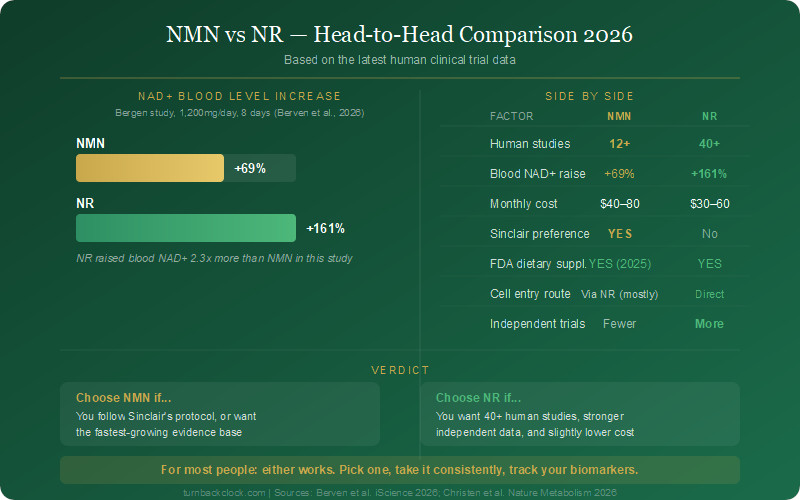
In the first truly controlled head-to-head human comparison, researchers gave healthy middle-aged adults 1,200mg/day of either NR or NMN for 8 days, then crossed over. Key findings:
- NR raised blood NAD+ levels by approximately 161% (a 2.3-fold increase)
- NMN raised blood NAD+ levels by approximately 69% (roughly double baseline)
- After 4 weeks of NR supplementation, brain NAD+ levels rose in healthy individuals
- Neither compound raised brain NAD+ in Parkinson’s disease patients in the 8-day phase
Source: Berven et al., iScience / Cell Press, February 2026
Study 2: Nature Metabolism Head-to-Head Trial, 2026
A separate head-to-head trial published in Nature Metabolism found a different result — that both NMN and NR doubled circulating NAD+ in 14 days at 1,000mg/day, with no statistically significant difference between them.
The discrepancy between these two studies is important and not yet fully resolved. The Bergen study used higher doses and shorter duration; the Nature Metabolism study used a 14-day protocol. Researchers note that dose, duration, and individual variation may all affect relative outcomes.
Bottom line on the 2026 data: Both precursors effectively raise NAD+. NR may have a numerical edge in blood NAD+ elevation at matched doses, but the practical difference for most people is not yet clear.
Evidence Base: Who Has More Human Studies?
This is where NR has a clear and significant advantage — for now.
- NR: Over 40 published human clinical studies covering heart health, metabolic function, neurological conditions, and exercise performance. The Tru Niagen patented NIAGEN form has been the subject of independent (non-supplement-funded) research
- NMN: 12+ published human trials as of 2026, covering NAD+ elevation, physical performance, sleep quality, insulin sensitivity, and telomere length. The pace of NMN research has accelerated dramatically since 2022
NR’s evidence base is more mature. NMN’s is smaller but deepening rapidly, and the FDA’s September 2025 confirmation that NMN qualifies as a dietary supplement removed a major regulatory cloud that had slowed US-based NMN research.
Price and Availability
NMN prices have fallen dramatically in recent years. As of 2026:
- NMN: Approximately 0–0/month for quality products (down from 00+ in 2020)
- NR: Approximately 0–0/month for quality products
The price gap has narrowed significantly. NMN is no longer the premium-priced outlier it once was.
David Sinclair’s View
Sinclair publicly prefers NMN and has taken it consistently since before Lifespan was published. He believes NMN has advantages in tissue-specific uptake over NR. It is worth noting that Sinclair’s view predates the 2026 head-to-head trials, and the Bergen study data showing NR’s larger blood NAD+ increase may prompt updated commentary from him in future interviews.
One Concern Worth Noting
A 2022 study found that NR supplementation increased cancer metastasis in a mouse model. This finding has not been replicated in humans, and it has not been observed with NMN. It is not a reason to panic — mouse models frequently do not translate to humans — but it is worth monitoring and discussing with your doctor if you have a personal or family history of cancer.
Who Should Take Which?
Based on the current evidence, here is a practical guide:
- Choose NR if: You want the supplement with the largest published human evidence base, the most independent studies, and slightly stronger blood NAD+ elevation data from the 2026 Bergen trial
- Choose NMN if: You follow Sinclair’s protocol, want the fastest-growing human evidence base, or find NMN more cost-effective from your preferred supplier
- Either works if: Your primary goal is simply raising NAD+ levels — the 2026 Nature Metabolism head-to-head found no significant difference at matched doses
- Avoid combining them: No evidence supports combining NMN and NR. Since both raise NAD+ through overlapping pathways, combining is unlikely to produce additive benefits
What to Expect When You Start
Set realistic expectations about timing:
- NAD+ blood levels increase within 1–2 weeks
- Subjective energy improvements typically emerge over 4–8 weeks
- Measurable metabolic changes such as insulin sensitivity improvements have been documented at 10 weeks
- Longevity benefits, if they exist, are measured in months and years — not days
Key Takeaways
- Both NMN and NR effectively raise blood NAD+ levels in humans — this is well established
- The 2026 Bergen head-to-head trial found NR raised blood NAD+ 2.3x more than NMN at matched doses; a separate Nature Metabolism trial found no significant difference
- NR has over 40 published human studies; NMN has 12+ and growing fast
- NMN prices have dropped significantly and now rival NR on cost
- David Sinclair prefers NMN; Tru Niagen’s NIAGEN (NR) has the most independent clinical backing
- For most people, either is a reasonable choice — pick one, take it consistently, and track your biomarkers
Ready to choose a product? Read our review: Best NMN Supplements in 2026 — Ranked by Purity and Evidence
References
1. Berven et al. Head-to-head comparison of NR and NMN. iScience, Cell Press, February 2026. https://www.nad.com/news/nr-raises-nad-over-2-fold-more-than-nmn-new-study-comparing-nad-precursors
2. Christen et al. Head-to-head human trial: NMN vs NR. Nature Metabolism, 2026. https://yourhealthier.com/blogs/blog/nmn-vs-nr
3. Tru Niagen. Nicotinamide Riboside vs NMN: Debunking the Science. https://www.truniagen.com/blogs/tru-niagen-labs/nicotinamide-riboside-vs-nmn-debunking-the-nmn-science
4. Grey Area Labs. NMN vs NR: 2026 Evidence Review. https://greyarealabs.co/2026/02/25/nmn-vs-nr-which-nad-precursor-is-actually-better-2026-evidence-review/
5. UT Cardiothoracic Surgery. NMN vs NR in 2026. https://utcardiothoracicsurgery.com/nmn-vs-nr-nad-precursors-compared/
6. GetHealthspan. NAD Supplements in 2025: NMN vs NR vs Liposomal vs Injectable. https://www.gethealthspan.com/research/article/nad-supplement-guide-nmn-nr-liposomal-injectable
© 2026 Turn Back Clock · turnbackclock.com · For informational purposes only. Not medical advice.