Short answer: if you would like to know whether you can still get up off the floor after 60, there is a simple home self-check for it, and you can get better at it with practice. Sit down on the floor and stand back up using as little help as you can, then give yourself a score out of 10. A low score is not a verdict. It is a starting line, and a few weeks of steady sit-to-stand practice beside a sturdy chair can make getting down and back up feel much less daunting. This guide is educational only, not personal medical advice.
“I avoided getting on the floor as I knew it would be difficult to get up. I needed to push myself up off a chair or other object.” That is how one woman in an online group for women over 60 described it. Then came the encouraging part: “After a month of 30 sit to stands about 4 times a week I can now get up off the floor with no hands.” Others in the same conversation said what many of us quietly think: “One of my biggest fears is to lose the ability to get up.” If that sounds familiar, you are in good company, and there is plenty you can do.
Why getting down to the floor and back up matters
Rising from the floor is one of those everyday skills we rarely think about until it becomes hard. Playing with grandchildren, finding something under the bed, gardening, an exercise class on a mat, or simply getting up after a slip all depend on it. It asks a lot of the body at once: leg and hip strength, a bit of flexibility in the hips and ankles, core control and balance.
Researchers in Brazil turned this skill into a simple test called the sitting-rising test, sometimes shared online as the “Sit-2-Rise” or floor rise test. In their first large study, published in 2012, about 2,000 adults aged 51 to 80 were scored from 0 to 10 and followed for around six years. People with lower scores had a noticeably higher long-term health risk than those with high scores, and each extra point was linked with better odds. A newer study from the same team, published in 2026, followed more than 4,200 adults aged 46 to 75 for a median of about 12 years and found the same pattern, including for heart health.
It is important to read that gently. These studies show a link, not a fixed future, and the test does not tell you how long you will live. What it does reflect is muscle strength, flexibility, balance and body composition, and all of those are things you can work on at any age. Think of it as a fitness check you can improve, much like the 30-second chair stand test.
Skip the floor test for now if any of these apply
Please do not try the floor version on your own if:
- you have had a hip or knee replacement, or other hip, knee or back surgery, unless your surgeon or physical therapist has said floor work is fine for you;
- you have had a recent fall or fracture, or you are afraid you may not be able to get back up;
- you get dizzy, lightheaded or faint when you stand up or change position;
- your blood pressure is not well controlled, or you have chest pain, unusual breathlessness or heart symptoms with effort;
- you have osteoporosis with a past fracture, a painful joint flare, or a recent injury;
- you are home alone with no phone within reach.
In any of these cases, start with chair-based checks instead, such as the chair stand test and the 4-stage balance test, and ask your doctor or a physical therapist when floor practice would be right for you. Our guide to simple home strength and balance tests walks through those step by step.
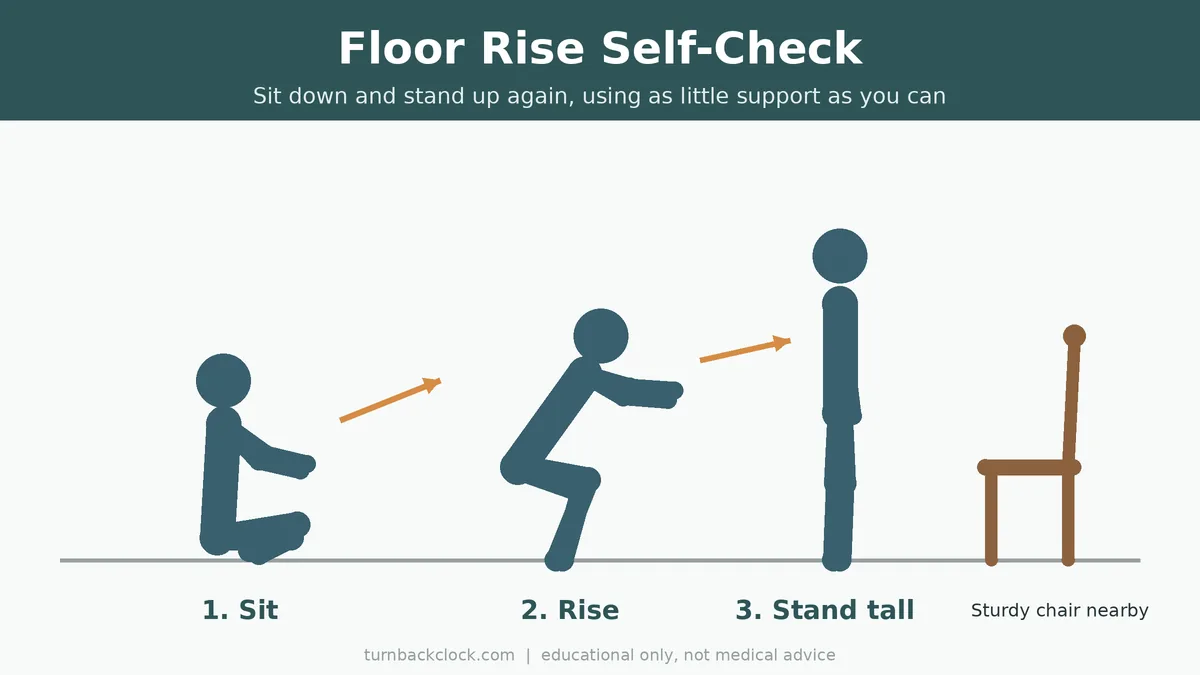
How to do the floor rise self-check
Set up first. Clear a space on a carpet or exercise mat. Put a sturdy chair with no wheels against a wall right beside you, so you can grab it at any moment. Wear non-slip socks or go barefoot, keep your phone nearby, and ideally have someone with you the first time.
- Sit down. Stand tall with your feet close together. Many people cross one ankle over the other, as in the research version, but feet side by side is fine. Slowly lower yourself until you are sitting on the floor, using as little support as you can.
- Pause. Sit for a breath or two. Notice how your hips, knees and back feel.
- Stand up. Now rise back to standing, again using as little help as you can. If you need the chair, use it. That is what it is there for.
Do it slowly. This is not a race, and there is no prize for speed.
How to score yourself, the simple way
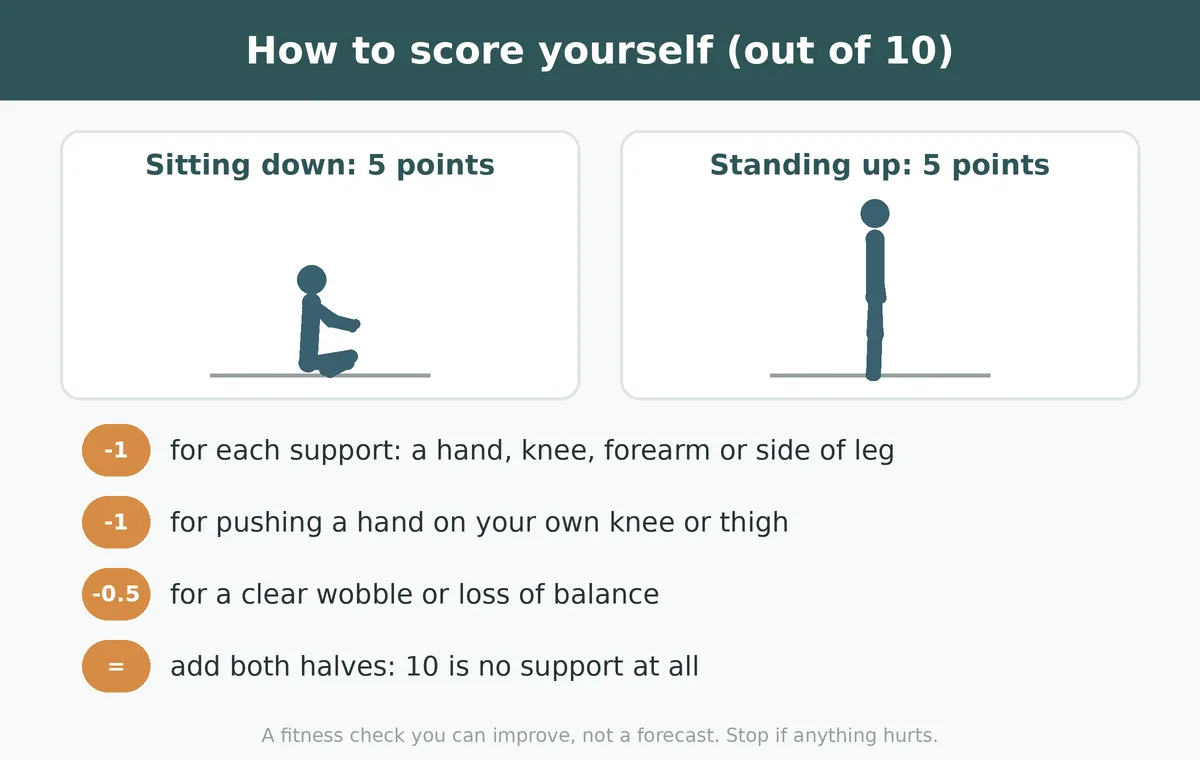
You start with 5 points for sitting down and 5 points for standing up, so a perfect score is 10. Then take points away:
- Minus 1 each time you use a hand, a knee, a forearm or the side of your leg on the floor for support.
- Minus 1 if you push a hand on your own knee or thigh, or hold onto the chair.
- Minus half a point for a clear wobble or loss of balance.
For example, if you sit down with one hand on the floor (4 points) and stand up using one hand and one knee (3 points), your total is 7. In the original study, researchers grouped scores into four bands: 0 to 3, 3.5 to 5.5, 6 to 7.5, and 8 to 10. Higher bands went with better long-term health, which is why even moving up a point or two is worth the effort.
Please do not be discouraged by your first number. Plenty of active people in their sixties and seventies need a hand. One 60-year-old in the same online group could rise with no hands or knees, while her 64-year-old husband still needed one hand. Write your score down with the date, and you will have something to beat in four weeks.
How to get up off the floor after 60 the safe way, with a chair
Whatever your score, it helps to practise a calm, reliable way up that uses a chair. It is the same method physical therapists often teach for getting up after a fall, and knowing you can do it takes away a lot of the worry.
- Roll and kneel. Roll onto your side, then push up onto your hands and knees.
- Crawl to the chair. Move to the sturdy chair and place both hands flat on the seat.
- One foot forward. Bring your stronger leg forward so that foot is flat on the floor, in a half-kneel.
- Push up and sit. Lean forward, push through your front leg and your hands, rise up, then turn and sit on the chair. Rest there for a minute before you stand.
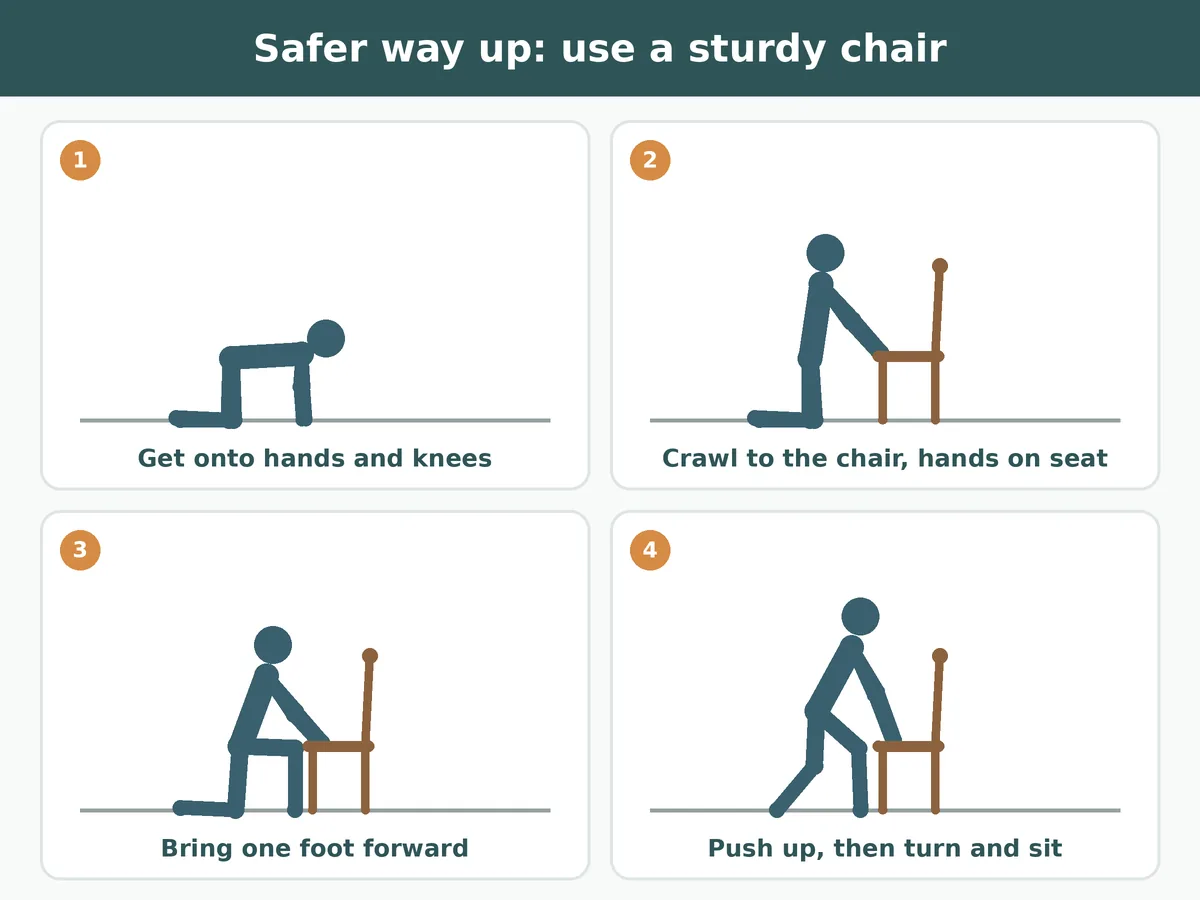
Getting down works the same way in reverse: hands on the chair seat, lower one knee to the floor, then the other, place your hands on the floor and ease onto one hip.
Get the Free Guide
Instantly receive Your Guide to Living 7 Years Longer — practical habits, evidence notes, and clear next steps. No miracle promises.
We’ll never share your email. You can unsubscribe anytime.
A 4-week sit-to-stand practice plan
The quickest route to a better floor rise usually starts in a chair, not on the floor. Sit-to-stands build the leg and hip strength you need, and by slowly lowering the seat height you teach your body to rise from lower and lower. Aim for three or four short sessions a week, with a rest day in between. If you are just starting, one woman’s tip from that online group is a good one: “start with 3 sets of 3-5.”
| Week | What to practise | How much |
|---|---|---|
| Week 1 | Stand up from a standard-height sturdy chair. Use your hands on the armrests or thighs if you need to. Practise the chair-assisted way down to the floor and back up once. | 3 sets of 3 to 5 |
| Week 2 | Same chair, arms crossed over your chest if you can. Lower yourself slowly, taking about three seconds to sit. | 3 sets of 5 to 8 |
| Week 3 | Use a slightly lower firm seat, such as a sturdy sofa edge or a low bench, with the chair still beside you. Add a few half-kneels next to the chair, switching legs. | 3 sets of 6 to 10 |
| Week 4 | Practise floor transitions beside the chair, using one hand on the seat, then as little help as feels safe. At the end of the week, redo the self-check and compare your score. | 2 or 3 slow transitions, plus 3 sets of sit-to-stands |
A little muscle tiredness is normal. Sharp pain, joint pain that lingers into the next day, dizziness or chest discomfort is not, so stop and check with your doctor. The CDC suggests that adults 65 and older do muscle-strengthening activities on at least two days a week, plus balance activities such as standing from a sitting position, so this plan fits neatly into those guidelines.
To round it out, add a few of our 10-minute chair exercises for better balance, the moves in our strength guide, or the simple balance exercises. If stairs are also starting to feel tougher, our guide on why stairs get harder after 70 uses many of the same muscles. Your hands help too when you push up, so our post on grip strength after 70 is a useful companion.
Keep track, and keep it going
Progress is easier to see when you write it down. Log each session in the free Health Habits Tracker, and redo the floor rise self-check once a month. For a broader picture of how you are doing, try the Longevity Score Calculator or the Biological Age Calculator, give your mind a workout with Memory Gym 50+, or browse all our free health tools. Our free Guide to Living 7 Years Longer brings the most useful everyday habits together in one place.
FAQ: getting up from the floor after 60
What is the sitting-rising test?
It is a simple test developed by researchers in Brazil. You sit down on the floor and stand back up, starting with 5 points for each half and losing a point each time you use a hand, knee, forearm or the side of your leg, and half a point for a wobble. A perfect score is 10.
Is it normal to find it hard to get off the floor after 60?
Yes, it is very common, because leg strength, hip flexibility and balance tend to drift down with age. The good news is that all three respond well to regular practice, even later in life.
What if I cannot get up off the floor at all?
Do not try the floor test alone. Start with sit-to-stands from a sturdy chair, practise the chair-assisted way up with someone nearby, and ask your doctor or a physical therapist for help building up safely.
Should I try this if I have had a hip or knee replacement?
Only if your surgeon or physical therapist has said floor work is safe for you. Some replacements come with movement limits, so chair-based tests are the better place to start.
How long does it take to improve?
It varies from person to person. Many people find sit-to-stands and floor transitions feel easier within a few weeks of practising three or four times a week, and the woman quoted at the top of this article could rise without hands after about a month.
Sources
- Brito LBB, Ricardo DR, Araújo DSMS, Ramos PS, Myers J, Araújo CGS. Sitting-rising test study in 2,002 adults aged 51 to 80. European Journal of Preventive Cardiology. 2014;21(7):892-898 (online 2012). PMID 23242910
- Araújo CGS, de Souza e Silva CG, Myers J, Laukkanen JA, Ramos PS, Ricardo DR. Sitting-rising test scores in 4,282 middle-aged and older men and women, prospective cohort. European Journal of Preventive Cardiology. 2026. PMID 40569873
- US Centers for Disease Control and Prevention. Older adult activity: an overview. cdc.gov
- National Institute on Aging. Three types of exercise can improve your health and physical ability. nia.nih.gov
Disclaimer: TurnBackClock.com shares educational information for adults 50+. Nothing here is medical advice, a diagnosis, or a treatment plan. Talk with your doctor or a physical therapist before starting a new exercise routine, especially if you have joint replacements, heart or blood pressure concerns, dizziness, or a history of falls.